Showing posts with label reading. Show all posts

A Trip to the Used Bookstore

by Senior Midnight Freemason Contributor
Gregory J. Knott 33° 


I love visiting used bookstores.  They are usually crammed with titles of books that are no longer in the mainstream stores such as Barnes & Noble.   The staff is typically very passionate about books and extremely helpful in assisting you in finding that nugget you are looking for.


I was in Springfield, Illinois on a recent trip and made a visit to the Prairie Archives Bookstore located across the square from the Old State Capitol and two doors down from Abraham Lincoln’s law office in historic downtown Springfield. 


Upon entering Prairie Archives, I was instantly absorbed into all the books in front of me.   This store has been around since 1973 and has established a reputation as being one of the premier used bookstores.  I spent considerable time browsing through shelf after shelf of treasurers who were just waiting for someone to pick them up.  Numerous titles caught my attention and it was all I could do to resist so many of them.   


My own personal book collection is probably now approaching a thousand books, so I have begun to try and focus my collection down into a few key areas, with Freemasonry being one of them.  Of course, there is always room for one more book, but I am working hard to be more disciplined with my book selections.


Prairie Archives is extremely well organized and has an extensive online database on Abe Books.  As I was making my rounds, one of the staff members asked me if he could help me find anything and I told him that I collected masonic-related books.   He asked me if I had seen the masonic section, and I told him I must have overlooked it.  I was shown where it was and I was pleasantly surprised by how many titles they had on hand.


As I started working my way through the shelves of books, I found titles from the Missouri Lodge of Research, the Masonic Book Club, proceedings from various masonic groups, and more.   Some great stuff.


I settled on four books that included Anderson’s Constitutions of 1738 reprinted by the Masonic Book Club in 1978 and A Daily Advancement in Masonic Knowledge, The Collected Blue Friar Lectures published by the Masonic Book Club in 2003.   I also picked up Sesquicentennial History of the Grand Commandery of Knight Templar of the State of Illinois 1857-2007 by Robert Baker Fisher and Grand York Rite Presiding Officers (Illinois) 1847-2007 by John Thomas Riedas, Sr.  I was extremely pleased with my new treasures.  


Support your local bookstores, buy new and used.   There are many books just waiting for you to rediscover them and share the knowledge they contain.


Serva Lectio - which is Latin for keep reading!


~GJK

Gregory J. Knott, 33° is a founding member and Senior Contributor of the Midnight Freemasons blog. He is a Past Master of St. Joseph Lodge No. 970 in St. Joseph (IL) and a plural member of Ogden Lodge No. 754 (IL), Homer Lodge No. 199 (IL) and Naval Lodge No. 4 in Washington, DC. He’s a member of the Scottish Rite, the York Rite, Eastern Star and is the Charter Secretary of the Illini High Twelve Club No. 768 in Champaign-Urbana. He is also a member of ANSAR Shrine (IL) and the Eastern Illinois Council No. 356 Allied Masonic Degrees. Greg serves on the Board of Directors of The Masonic Society and is a member of the Scottish Rite Research Society and The Philathes Society. He is a charter member of a new Illinois Royal Arch Chapter, Admiration Chapter U.D., and serves as its Secretary. Greg is very involved in Boy Scouts—an Eagle Scout himself, he is a member of the National Association of Masonic Scouters.

Masonic Publications to Look Into

by Midnight Freemason Contributor
Robert H. Johnson


Often times we find ourselves looking for something to read or maybe just wishing for it. If you're lucky enough to have free time that doesn't require also splitting it with paying attention to the little ones, congratulations...I digress.

As a podcaster I find myself constantly looking for material to either write about or read on the show, (if the publication is cool with it). The list of publications I'll give here are ones that I enjoy, even though some of them do not allow reprinting or readings ;) Take a look and if I can assist you in answering questions about them, please feel free to email me.

The Plumb Line - A publication of the AASR Research Society. You essentially join the Research Society. Cost is about $50 and you get a quarterly newsletter (usually with a great article in each one) and a hard cover book (usually by de Hoyos). Totally worth it.

The Fraternal Review - Probably the hippest and most relevant in terms of knowing what it's readers love, and is inexpensive for what you get. 11 issues for $37. In fact probably the coolest damn thing is that they do is a "Lodge Subscription" for $92. A lodge subscription gets you 3 physical print copies of each issue. They also offer a digital subscription for $27. It's printed on nice paper, is in color and usually comes in the usual length of a good magazine, sans all the advertisements. Just do it.

The Journal - A publication of the Masonic Society is  similar in nature to the Philalethes. Cost is $45 per year and is released quarterly. This magazine is also printed in a very nice way. Full color, good paper weight and consists of slightly more academic papers. They adhere to their quarry style guide as well, which is Like Chicago Style. Anyone in good standing can subscribe. Cost is $45.

The Philalethes - The oldest Masonic research publication in the United States, the Philalethes is Americas version of AQC, (at least that's how it feels to me.) In any case, this publication is also in color, published quarterly and has good paper weight. The cost is $50 for 4 issues.

The Rocky Mountain Mason - Another full color Masonic publication with great articles and who is more concerned with it's readership than the pomp and circumstance of other publications. That is not to say that those who are published in the magazine are not scholars, to the contrary they are. In fact many propose amazing and new research not examined before. Subscription to this publication will set you back a whopping $33 bucks for this quarterly masterpiece. ( I'm not being sarcastic. I legitimately enjoy the heck out of this one.)

The Working Tools by Cory Sigler was a wonderful magazine as well. Alas it's no longer in print. In addition, The Living Stones magazine which was published by Robert Herd was also just amazing. Although it too is out of print, Robert made all issues available for free in digital format. You can access them at the link below. CLICK HERE TO ACCESS THE LIVING STONES MAGAZINE.

Happy subscribing and happy reading everyone!

~RHJ

RWB, Robert Johnson is the Managing Editor of the Midnight Freemasons blog. He is a Freemason out of the 1st N.E. District of Illinois. He currently serves as the Secretary of Spes Novum Lodge No. 1183 UD. He is a Past Master of Waukegan Lodge 78 and a Past District Deputy Grand Master for the 1st N.E. District of Illinois. Brother Johnson currently produces and hosts weekly Podcasts (internet radio programs)Whence Came You? & Masonic Radio Theatre which focus on topics relating to Freemasonry. He is also a co-host of The Masonic Roundtable, a Masonic talk show. He is a husband and father of four, works full time in the executive medical industry. He is the co-author of "It's Business Time - Adapting a Corporate Path for Freemasonry" and is currently working on a book of Masonic essays and one on Occult Anatomy to be released soon.

So You Want To Be A Masonic Writer Pt. 2: Avoiding the Slings and Arrows

by Midnight Freemason Contributor
Steven L. Harrison, 33°, FMLR


As all of us "Midnight Freemasons" have experienced, it's a rewarding thing to draft an article, hone it and have it published. Sometimes those articles fly off the keyboard at the speed of light. Most times, however, it's a lot of work. I'll bet each one of us has a few tips and tricks to help make things easier; and I wouldn't be surprised if those tricks differ from individual to individual. Here, in no particular order, are some of mine:

Good writing starts with good research. OK, maybe there is, in fact, some sort of order to these tips. Research comes before writing. It's a real shame that, in order to speak as an authority on a subject, you have to know something about it. Sarcasm aside, some enjoy the research while some find it tough. Either way it's usually the most time-consuming part of writing. Still, you've got to do it — two corroborating sources for every fact. Oh, and, by the way, Wikipedia doesn't count. Don't make me take the next 1,000 words saying why. Just take my word for it.

Get a handle on grammar. It sometimes seems everyone thinks they are… uh… I mean he or she is better at grammar than everyone else. The grammar police are all over the Internet. If you don't believe me, just post something like, "Your right if you think the Lodge had performed there best degree work last night." That sentence just screams for a visit from the grammar police. Check out Grammarly (https://app.grammarly.com/) or the Grammar Girl (http://www.quickanddirtytips.com/grammar-girl) for your grammar police get-out-of-jail-free card.

Give credit where credit is due. Never, never, never quote another author or source without giving credit. The thing is, if you quote another author and cite his work, it actually makes you look better and smarter. I had so many footnotes in my first book one Brother called it "very academic." I'm no academic. What's more, someday you may be on the other end of things. A few years back some creep (it's not name-calling if it's true) in Texas was plagiarizing the Midnight Freemasons almost on a daily basis. It's infuriating.

Get a personal editor. Any publication you write for will have its own editor — Robert Johnson, for example, in the case of the Midnight Freemasons blog. However, it's a good practice to have someone you can rely on to review your work before you submit it. I can honestly say I've never had someone look over my work and suggest changes that it didn't turn out to be a better piece. My wife Carolyn does this for me. She's so smart I figure if I write something she can't understand then no one will understand it. Other than that, the fact she's smarter than me usually works to my disadvantage.

Develop a thick skin. You will be rejected, criticized, even maligned. At some point, all writers suffer the slings and arrows of outrageous… readers. If you make a mistake admit it, correct it and move on. I once made the heinous mistake of calling a destroyer a battleship. I've heard from everyone but the Secretary of the Navy about that. If you get unwarranted criticism, don't let it get to you. I once wrote a Scottish Rite article… subject withheld so we don't get anyone riled again… that drew nuclear criticism from a pretty important member. The whole kerfuffle went to my Personal Rep, SGIG and finally to someone at the House of the Temple. In the end I came out OK. Why? Refer back to the advice on good research.

Write a little in order to write a lot. I don't suffer much from writer's block. If I get stuck I just tell myself, "Write a paragraph… even a bad paragraph. You can change it later." Usually, once I have that sticky paragraph out of the way things begin to flow again. This little trick, however, goes further than getting articles done. I also use it to write books: write a chapter, turn it into an article and publish it. That's how I got my first book out the door. Almost every chapter was revised from an article I published. For my second book, Tales From the Craft, I wrote one "tale" per day and published it on my blog. After a couple years of that, I had a book's worth of material.
And finally… For God's sake, write in the active voice. If you don't know what that is, your next assignment is to look it up and embrace it.

Remember, these are just some of the personal tricks I use when I write. Everyone is different and may have different ways of accomplishing the same thing. Maybe my final tip is to talk to other writers and find out what works for them. Then apply what you've discovered to see what works for you; and when you find something, let us all know. The learning process never stops.

~SLH

Bro. Steve Harrison, 33° is Past Master of Liberty Lodge #31, Liberty, Missouri. He is the editor of the Missouri Freemason magazine, author of the book Freemasonry Crosses the Mississippi, a Fellow of the Missouri Lodge of Research and also its Worshipful Master. He is a dual member of Kearney Lodge #311, St. Joseph Missouri Valley of the Scottish Rite, Liberty York Rite, Moila Shrine and a member and Past Dean of the DeMolay Legion of Honor. Brother Harrison is a regular contributor to the Midnight Freemasons blog as well as several other Masonic publications. His latest book, Freemasons: Tales From the Craft & Freemasons at Oak Island. Both are available on amazon.com.

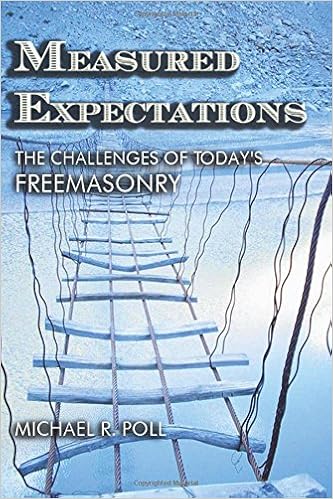
Measured Expectations - A Review of Michael R. Poll's New Book

by Midnight Freemason Contributor
WB Adam Thayer


One of the greatest duties I’ve been called for as a writer is to be a book reviewer. Not only does it afford me the opportunity to count my reading time as “work”, but it exposes me to multiple great works that I might otherwise never have discovered. Such is the case with “Measured Expectations: The Challenges of Today’s Freemasonry” by Michael R. Poll, which I only learned of when I was asked to review it.

I have enjoyed Brother Poll’s other works greatly, and specifically his Masonic edition of “Robert’s Rules of Order” has proven an invaluable reference during my time as Worshipful Master. If you have ever read any of his books on philosophy or esotericism, you should have a rudimentary idea of what to expect here.

This book (as with many of Brother Poll’s other books) isn’t necessarily intended to be read start to finish, although you are definitely welcome to do so. Instead, each chapter serves as a short stand alone education piece, suitable for either private reflection or for a supplement to your lodge’s education program. As such, it becomes very difficult to review this as a “book”, and we must instead look at it as a collection of papers sharing the same basic theme.

With any collection such as this, there will be some works that are stronger than others, and some that are more meaningful to you in your current journey than the rest. If I had my way, every single Mason would read the first paper, titled “A Young Man Joins A Masonic Lodge,” before their annual elections. I believe this one paper to be of such high importance to understanding the current problems in Freemasonry that I think it should be distributed as far as possible, and this paper alone is worth the purchase price of the book.

Another paper that I found fascinating had to do with the symbolism and history of the double headed eagle. I would love to see the ideas in this chapter expanded on, as it could almost be a book to itself. My only frustration is that it was much too short, and Brother Poll had to stop the article before really delving deeply into the ideas he brought up.

The remainder of the papers in the book delve into subjects such as music, the history and role of ritual, understanding the culture of different lodges, and a brief examination of the modern Scottish Rite. Conspicuously absent is any discussion of the York Rite; I’m not certain if Brother Poll does not find it an interesting topic, or if he doesn’t feel qualified to discuss it, however I would have loved to see his take on the modern York Rite in the same manner he discusses the Scottish Rite.

“Measured Expectations” is necessarily repetitive at times; as a collection of papers, some themes are touched on in multiple different papers, and each time it is from the standpoint that you did not read any of the previous papers. This isn’t a bad thing, since the intention is to use each chapter by itself, however it is something to be aware of if you choose to read it start to finish as I did.

The intention of this book is to help brothers who are newer to Masonic education find a foot in the door, and it exceeds expectations for that. The topics presented and writing style are all simple enough for a newer Mason (or one who is just finding an interest in learning more) to gain significant insight from, without boring the more experienced Mason. If this book makes you curious to start doing more in-depth research on your own, Brother Poll should consider himself highly successful.

~AT

WB. Adam Thayer is the Senior Warden of Lancaster Lodge No. 54 in Lincoln (NE) and a past master of Oliver Lodge No. 38 in Seward (NE). He’s an active member in the Knights of Saint Andrew, and on occasion remembers to visit the Scottish and York Rites as well. He continues to be reappointed to the Grand Lodge of Nebraska Education Committee, and serves with fervency and zeal. He is a sub-host on The Whence Came You podcast, and may be reached at adam@wcypodcast.com. He will not help you get your whites whiter or your brights brighter, but he does enjoy conversing with brothers from around the world!

Lighten Up Francis

by Midnight Freemason Contributor
WB Adam Thayer


With apologies to our ever-patient editor, Robert.

I recently enjoyed a discussion with some of the other Midnight Freemasons, regarding page views (which is the only solid metric we have to measure our success) and how we had noticed a correlation between the depth of the topic discussed and the amount of viewers that we reached. Of course, if you’ve ever been involved in any organized Masonic education, you’ve had this discussion too; in fact, the Nebraska Grand Lodge Education Committee has it ever year when we’re planning our topics!

As educators, we all want to dig deep into the guts of Freemasonry and teach how it ticks, but unfortunately this turns off many of the people we are trying to reach, who would much prefer something lighter and more easily digestible. Those few scholars who do brave the depths of our more advanced topics are rewarded with a wealth of knowledge, but the more average Mason wouldn’t get past the headline “A Judeo-Christian Examination of the Middle Chamber Lecture”. (That was not a random example, it’s a paper I’ve been dying to write)

As entertainers (and let’s be honest, that is a part of our job as well), we are under the constraint of giving the public what they want, even at the cost of sacrificing some of our deeper esoterica. If we do our jobs perfectly, you will be entertained, and you will learn something in the process. If done poorly, we either write something fun with absolutely no substance, like we’re the pop musicians of Freemasonry, or we write something so dense that nobody can understand it, like modern day Albert Pikes.

The issue becomes this: what level do we write at, to pull in new viewers, to keep our current readers coming back, and to bring back viewers we may have lost. Does that sound familiar? What if we substituted “viewers” for “brothers”? Isn’t that the same issue that most of our lodges are having right now? In my Scottish Rite valley, it is referred to as “The Three R’s”: recruitment, retention, and reinstatement.

In education, if you’re very lucky, you have someone with a big-picture view to balance out the needs of the viewers with the needs of the writers, and we’re blessed to have an editor who keeps us in line but still gives us the freedom to write what we want, and for that I am infinitely thankful.

So, now I’m going to turn the question around to you: what do YOU want to see here? We have this great feedback section at the bottom of every post, we would love for you to use it!!! Let us know if there’s something you want to read about. If you read one of our papers and want more like it, tell us. If you think we’re completely wrong about something (it happens more than you think), tell us. Page hits is only a useful metric to track how many eyeballs we reached, but what we really want to know is how many minds did we reach!

~AT

WB. Bro. Adam Thayer is the Senior Warden of Lancaster Lodge No. 54 in Lincoln (NE) and a past master of Oliver Lodge No. 38 in Seward (NE). He’s an active member in the Knights of Saint Andrew, and on occasion remembers to visit the Scottish and York Rites as well. He continues to be reappointed to the Grand Lodge of Nebraska Education Committee, and serves with fervency and zeal. He is a sub-host on The Whence Came You podcast, and may be reached at adam@wcypodcast.com. He will not help you get your whites whiter or your brights brighter, but he does enjoy conversing with brothers from around the world!

Truman's Study

by Midnight Freemason Contributor
R.W.B. Michael H. Shirley


“He that loves reading has everything within his reach.”
William Godwin


Truman Home
One of the things I’d always wanted growing up was my own library. I made stabs at it over the years, and once managed to put 2000 books on metal shelves in a 9X12 room (it was laid out like a maze, and didn’t look great, but I had my books on shelves, which is what mattered). Still, my library was really only a dream until we moved into our current home. In the old dining room, we had floor to ceiling shelves built, and I scored a rolling library ladder on eBay (complete with a sign hanging from one rung: “For Staff Use Only. Please Ask For Assistance”). We finally managed to get the right furniture (my wife is a Black Belt in Craigslist), and lately we’ve been spending at least an hour every morning reading in our favorite chairs. And it was there, the other day, that I found myself thinking of Harry Truman.
Truman, reading in his late years.

A couple of years ago, I was in Fort Leavenworth, Kansas, for a teaching military history course, and found myself with an unscheduled weekend. Since Harry Truman is my favorite president, and his presidential library and home were nearby in Independence, Missouri, I decided to have a Truman day. 

I started at the Harry S. Truman Library and Museum. I’d never been to a presidential library, so I wasn’t sure what to expect, but I was pleased to see it was on a human scale, with changing exhibits on American history, and permanent ones on President Truman’s life and career. Curiously, my favorite room wasn’t the oval office replica, or any of the galleries, but Truman’s own office, which he designed, and where he worked on his various projects and received visitors after he left the White House.


Truman's office
It’s a thoroughly satisfactory room, with a big wooden desk, leather armchairs, a massive globe, and bookshelves along the walls. It’s on display behind glass, and looks just as it did when he worked there. The books aren’t just for display. He read at that desk, but his primary reading was done at his home, where I drove next. It’s maintained by the National Park Service, and is much as it was when Truman and his wife Bess lived there. They had lived there from the beginning of their married life, but only inherited it from Bess’s mother, Madge Gates Wallace, in 1952. It’s a stately and handsome house, but, like the Library, is very much human in scale. The tour was excellent and informative, and the whole house was interesting, but I had only one room that I truly wanted to see: the study. It was Truman’s favorite room, lined with books and furnished with his and Bess’s reading chairs. If any word can describe Harry Truman, it’s “reader.”
Truman's Reading Chair 

Truman’s reading habit began early. In a letter to Dean Acheson in 1962, he wrote that, when he was a boy, “Our public library in Independence had about three or four thousand volumes, including the then encyclopedias. Believe it or not I read 'em all….” He read mostly history and biography, because it interested him, and he was sure that it was his reading that made him what he was: “Readers of good books,” he wrote, later in his life, “particularly books of biography and history, are preparing themselves for leadership. Not all readers become leaders, but all leaders must be readers.”

My reading room.
I fancy myself a reader, too, and that may be part of what draws me to Truman and drew me to the rooms in which he spent so much time: a sense of kinship, an understanding of the importance of a good chair in a room laid out just so, with the comfort of reading the primary aim of its design. As I sit in my own reading chair, in my home library, my current book open in my lap, I sometimes think of him, and the other readers of my acquaintance, and feel grateful for those who understand what it means to lose oneself in words. I confess that I don’t understand people who don’t like to read. Thomas Jefferson once wrote to John Adams, “I cannot live without books.” Neither could Truman. Neither can I. No reader can. And why would we want to? We have the world within our reach.

~MHS

R.W.B. Michael H. Shirley serves the Grand Lodge of Illinois, A.F. & A.M, as Leadership Development Chairman and Assistant Area Deputy Grand Master of the Eastern Area. A Certified Lodge Instructor, he is a Past Master and Life Member of Tuscola Lodge No. 332 and a plural member of Island City Lodge No. 330, F & AM, in Minocqua, Wisconsin. He currently serves the Valley of Danville, AASR, as Most Wise Master of the George E. Burow Chapter of Rose Croix; he is also a member of the Illinois Lodge of Research, the York Rite, Eastern Illinois Council No. 356 Allied Masonic Degrees, Eastern Star, Illini High Twelve, and the Tall Cedars of Lebanon. The author of several articles on British history, he teaches at Eastern Illinois University.You can contact him at: m.h.shirley@gmail.com