Showing posts with label book review. Show all posts

Now in Paperback! The Better Angels of Our Nature - Review

by Midnight Freemason Contributor
by Robert H. Johnson


Editors note - This review was first published a few years ago. However, I have updated it because it's now out in paperback. I for one am very excited about this. You can pick up the new paperback HERE.


Several years ago, I reviewed an older book, which I found to be excellent. It was called A House Undivided. I had followed this up about a year later with a similar book, in that the subject matter was the same. However, this particular book, The Better Angels Of Our Nature - Freemasonry In The American Civil War, is not so much a collection of colorful anecdotes as the previous book had been. Instead, it was a real investigation into Civil War stories, verified using real scholarly work. Many Civil War stories have embellishments and unbelievable outcomes. This new book cleared it all up.

In the first chapter, it opens up with a doorbuster. Using all the resources available and even written accounts, Halleran proves that Hancock and Armistead's highly regarded story never happened. This story, forever memorialized in the "Friend To A Friend" Masonic Memorial at Gettysburg, and also the basis of the 26th Degree in the Ancient Accepted Scottish Rite of the Northern Masonic Jurisdiction, is false. It's a great story, but it just isn't true.

After that substantial disappointing blow, the book goes on, and I prepped myself for further disappointments. But my disappointment was staved off. Instead, I had confirmation after confirmation of even more amazing stories regarding the influence of the gentle Craft in wartime. In fact, many of the stories which were confirmed were more fantastic than any other stories I had heard before. Stories that pulled at your heartstrings and made you think about the times and situations these Brothers had been in. Cover to cover, the book draws you in.

The book's overwhelming and underlying question or theme seems to be-- "What was it about the Masonic Obligation that superseded the rules of war?". This was a question that the book guides you into asking yourself as you hear story after story of verified fraternalism on the battleground. Stories of soldiers "accidentally" escaping and lodges being fashioned in prison. Even enemy officers of those prison camps attending the prisoner based lodges—all verified through journal entries and cross-referenced in other journal entries by the actual Brothers who were there!

Mike Halleran even goes to the lengths of inspecting sources that were not Masonic. Journal entries by the profane of the period. In these entries, the profane complain that Masons got better treatment and even were let go on occasion—it was "unfair." These profane often wrote in their journals of how, when the time would present itself, they too would join the fraternity out of witnessing the bonds that had been on display to them during the war.

The book does a fantastic job of verifying, separating truth from colorful anecdotes, and disproving Masonic "whoppers". I say this book is a must-read. Where "A House Undivided" brings you the fairytales, perhaps this book brings you the straight dope on what happened, and in the end, this book proves we are indeed the greatest fraternity in the world.

Just recently, the book has been released for the first time as a paperback. If you've been waiting to pick this book up, now is the time. It's never been more accessible. Pick up the book at this link.

~RHJ

RWB Johnson is a Co-Managing Editor of the Midnight Freemasons blog. He is a Freemason out of the 2nd N.E. District of Illinois. He currently serves as the Secretary of Spes Novum Lodge No. 1183. He is a Past Master of Waukegan Lodge 78 and a Past District Deputy Grand Master for the 1st N.E. District of Illinois. Brother Johnson currently produces and hosts weekly Podcasts (internet radio programs) Whence Came You? & Masonic Radio Theatre which focuses on topics relating to Freemasonry. He is also a co-host of The Masonic Roundtable, a Masonic talk show. He is a husband and father of four, works full time in the executive medical industry. He is the co-author of "It's Business Time - Adapting a Corporate Path for Freemasonry" and is currently working on a book of Masonic essays and one on Occult Anatomy to be released soon.

Scottish Rite Northern Masonic Jurisdiction Looks Forward

by Senior Midnight Freemason Contributor
WB Gregory J. Knott


Illustrious John Wm. McNaughton 33°, the immediate Past Sovereign Grand Commander of the Ancient Accepted Scottish Rite, Northern Masonic Jurisdiction (AASR-NMJ) has written a new book titled Reclaiming the Soul of Freemasonry. It is available online in the Scottish Rite store or on Amazon in the Kindle version.

Brother McNaughton lays out his opinions on the current state of Freemasonry and in the forward writes:

“Today, many Masonic leaders no longer prioritize the same lofty ideals as did our forefathers. Focus has turned from the timeless principles of our craft to the ephemeral practice of arbitrarily enforcing rules and regulations. It is painful to think about what happened to the golden age of Freemasonry, when our members cared more about each other than about edicts and procedures. Today, it seems that some leaders of the fraternity are more concerned about the needs of the institution than the needs of the members. Buildings come first. Ritual comes first. Procedures come first. Everything but our obligation to each other has been given priority.”

In many ways, I believe McNaughton is spot on with this assessment. Think about the meetings of your local lodge or appendant bodies. What percentage of time is spent on topics such as the roof on the building, planning the pancake breakfast or reading the mail? What percentage of your meeting is spent on education? My bet in 99% of the cases is that education is a very small part, if any of your meeting.

AASR-NMJ commissioned a study whose purpose was to examine the issues within the fraternity and solicit input from both members and non-members. The survey itself was not included in the book, but McNaughton makes several references to what was found.

He writes that the survey makes an examination of the Millennial and Boomer generations, finding both generations share similar priorities such as wanting to be part of organization that makes a difference and the desire to be heard and respected. Common shared values included loyalty, authenticity and equality.

The conclusion is drawn that the Boomer generation should be the target market for recruiting new members into Freemasonry. That by doing so will ignite a generational interest that will in time also attract the Millennial generation to also join.

The book then explores what the survey said was the right message to attract new men to Freemasonry. Respondents essentially said they were much more interested in an organization that espoused the values they stood for and not long dead historical Masons.

The internal membership survey asked what current Scottish Rite members expect from the fraternity. Three primary areas were identified: first was that Scottish Rite members want more interaction with their leadership, more engagement with one another, and the ability to dive deeper into the craft (education). Second members stated they wanted to see more modern communication methods to enhance the member experience. Finally, the biggest challenges facing the Scottish Rite are related to interpersonal conflicts. The last point is explored in detail.

Brother McNaughton then explores the topic of ritual memorization and its relationship to leadership within the fraternity. Does the ability to memorize equate to the value a member can bring to the fraternity? Again, he explores this at some length.

The book looks at technology, member education and the Scottish Rite membership’s desire to have more of both and integrated together. Not for supplanting social gatherings or interpersonal relationships, but to further build their individual masonic knowledge.

AASR-NMJ emphasizes brothers caring for one another, which McNaughton argues is a critical step into keeping our obligation and as a key element for attracting new members into our ranks. He concludes that it is this obligation that should be emphasized and that the survey results verify this is where the organization and Freemasonry should go.

I agree with much of what Brother McNaughton has written. However, I do have concerns that the Boomer generation should be the primary target of membership growth. While I agree that many in this age group may have more free time than younger generations who are engaged in careers and/or raising children, I personally have found that these groups are also ripe for membership growth.

It was unclear to me the role member education will play in attracting new members in the new plans, but I am hopeful it will be a center piece, not only for attracting new members, but also for the existing membership. I firmly believe that masonic education is vital to both attract and retain members not only in the Blue Lodge, but also in the local Scottish Rite Valley, where it is virtually non-existent today.

I concur with McNaughton in regard to ritual memorization. Yes, I understand that ritual when done right necessitates having the parts memorized. This has been a timeless means of portraying our degrees to the candidate. But too often the ability to memorize is considered the key attribute to providing leadership within Masonry. While I am impressed with the ability of those who can memorize long passages of ritual, I often wonder if they have any idea what it means.

Overall, I think this is a well written book. I have seen comments questioning the methodology of the membership survey and as stated earlier the detailed survey results are not included in the book. But I will reserve my final opinions until I have an opportunity to see what the AASR-NMJ will be rolling out. Without a doubt, there will be many critics of what comes forth and that is OK, good civil debate is sorely needed within our fraternity, especially about our future.

Regardless I think we owe Brother McNaughton a debt of thanks for getting this process started and sharing his thoughts on how the fraternity, both the Blue Lodge and Scottish Rite should go into the future.

He cares deeply about our fraternity and so do I.

~GJK

WB Gregory J. Knott is the Past Master of St. Joseph Lodge No. 970 in St. Joseph (IL) and a plural member of Ogden Lodge No. 754 (IL), Homer Lodge No. 199 (IL) and Naval Lodge No. 4 in Washington, DC.

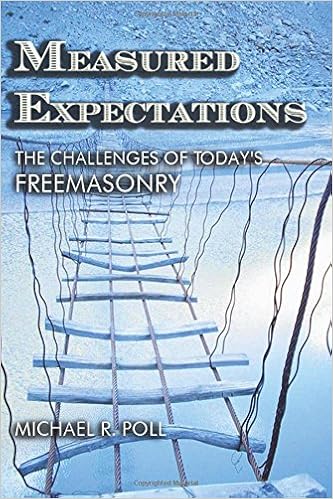
Measured Expectations - A Review of Michael R. Poll's New Book

by Midnight Freemason Contributor
WB Adam Thayer


One of the greatest duties I’ve been called for as a writer is to be a book reviewer. Not only does it afford me the opportunity to count my reading time as “work”, but it exposes me to multiple great works that I might otherwise never have discovered. Such is the case with “Measured Expectations: The Challenges of Today’s Freemasonry” by Michael R. Poll, which I only learned of when I was asked to review it.

I have enjoyed Brother Poll’s other works greatly, and specifically his Masonic edition of “Robert’s Rules of Order” has proven an invaluable reference during my time as Worshipful Master. If you have ever read any of his books on philosophy or esotericism, you should have a rudimentary idea of what to expect here.

This book (as with many of Brother Poll’s other books) isn’t necessarily intended to be read start to finish, although you are definitely welcome to do so. Instead, each chapter serves as a short stand alone education piece, suitable for either private reflection or for a supplement to your lodge’s education program. As such, it becomes very difficult to review this as a “book”, and we must instead look at it as a collection of papers sharing the same basic theme.

With any collection such as this, there will be some works that are stronger than others, and some that are more meaningful to you in your current journey than the rest. If I had my way, every single Mason would read the first paper, titled “A Young Man Joins A Masonic Lodge,” before their annual elections. I believe this one paper to be of such high importance to understanding the current problems in Freemasonry that I think it should be distributed as far as possible, and this paper alone is worth the purchase price of the book.

Another paper that I found fascinating had to do with the symbolism and history of the double headed eagle. I would love to see the ideas in this chapter expanded on, as it could almost be a book to itself. My only frustration is that it was much too short, and Brother Poll had to stop the article before really delving deeply into the ideas he brought up.

The remainder of the papers in the book delve into subjects such as music, the history and role of ritual, understanding the culture of different lodges, and a brief examination of the modern Scottish Rite. Conspicuously absent is any discussion of the York Rite; I’m not certain if Brother Poll does not find it an interesting topic, or if he doesn’t feel qualified to discuss it, however I would have loved to see his take on the modern York Rite in the same manner he discusses the Scottish Rite.

“Measured Expectations” is necessarily repetitive at times; as a collection of papers, some themes are touched on in multiple different papers, and each time it is from the standpoint that you did not read any of the previous papers. This isn’t a bad thing, since the intention is to use each chapter by itself, however it is something to be aware of if you choose to read it start to finish as I did.

The intention of this book is to help brothers who are newer to Masonic education find a foot in the door, and it exceeds expectations for that. The topics presented and writing style are all simple enough for a newer Mason (or one who is just finding an interest in learning more) to gain significant insight from, without boring the more experienced Mason. If this book makes you curious to start doing more in-depth research on your own, Brother Poll should consider himself highly successful.

~AT

WB. Adam Thayer is the Senior Warden of Lancaster Lodge No. 54 in Lincoln (NE) and a past master of Oliver Lodge No. 38 in Seward (NE). He’s an active member in the Knights of Saint Andrew, and on occasion remembers to visit the Scottish and York Rites as well. He continues to be reappointed to the Grand Lodge of Nebraska Education Committee, and serves with fervency and zeal. He is a sub-host on The Whence Came You podcast, and may be reached at adam@wcypodcast.com. He will not help you get your whites whiter or your brights brighter, but he does enjoy conversing with brothers from around the world!