Showing posts with label master mason. Show all posts

The Three Degrees of Chi Kung

by Midnight Freemason Contributor
Bro. Ken JP Stuczynski


In the West, we tend to boldly demark the concepts of body and mind from one another -- the physical from the psychical (mental and/or spiritual). The traditional Chinese perspective looks at the body (or one's being) being a composite, with the physical body as a component of one's self. It's not merely a shell, and certainly not sinful or oppositional by nature as in Western traditions.

Mind you, there's nothing wrong with a simple Body-Mind duality. The Square is about actions and is used to measure relationships in a three-dimensional existence; the Compasses are a drafting tool for discernment and willful boundaries.

But perhaps a more pertinent model for our various Degrees is the trinity of body, mind, and spirit. According to George Harold Steinmetz, in "The Royal Arch, its Hidden Meaning", as well as other Masonic authors in various works, the Degrees show a progression of growth through those parts of our being. It isn't hard to see how the Entered Apprentice Degree deals with the physical, the Fellowcraft with the mental, and Master Mason Degree with the Spiritual. We go from the quarries of measuring and manipulating the objects of the physical world, to the arts and sciences, to the transformation of our mortal, yet immortal existence.

It is no wonder the Square takes precedence in the configuration we first behold at the Altar, the Compasses at last, and a partial transcendence of the physical into the spiritual when we are Passed. The ritual describes our progression in our Moral Science as being -- by necessity -- by degrees.

So why bring up an Eastern model of human existence? Because there are aspects of the model that grant us other insights. Any framework of understanding can yield results unique to it, and Traditional Chinese Medicine is one of them, particularly in its Taoist roots.

The ancient Taoist physiology focuses on the "Triple Burner" system -- three energy fields in the body called dan tiens. These are NOT point-like chakras and are often poorly equated with them or other Indian concepts. And most martial arts don't even mention there are three of them, as only the lower one is used in martial training.

The lower dan tien, just below the navel, could be described as the home of jing, physical essence. I teach my students that it is the geographic center of the physical body, and if it were stiff, dead weight, that's where you could place a fulcrum to balance it like a see-saw. (Don't try this at home.)

The middle dan tien, around the diaphragm, is the home of chi, literally meaning breath. Of course, the concept of breath is hardly limited to moving oxygen but is an energetic, whole body (or even body-and-beyond) experience. (I've written on this subject before, but won't get into its metaphysical nature or theological implications here, as it would detract from the point of this article.)

The upper dan tien could be thought of as the "third eye", or seat of spirit. This completes a trinity of places to focus the physical (body), the non-physical (spiritual), and the bridge between them (chi).

So, where am I going with this? The ancient Taoist text, "Cultivating Stillness"*, expounds a regimen of chi kung (roughly meaning "breath training") for the purpose of immortality. Let's not argue over how literal or possible its goal is intended to be. The important thing is that this is a journey for the whole person. Every aspect of one's being affects the others. The progression described is an effort to use the jing to "purify" the chi, and then the chi to purify shen.

Like the deep lessons of our degrees, you can't jump ahead. It would devastate the impact of the Third Degree by not having experienced the first two. The power of the Royal Arch Degrees would be wasted if endowed upon the profane -- there's a reason you have to be a Master Mason to receive them (and be a Past Master, but let's not bog ourselves down here explaining that).

Each Degree builds on the former. The First sets the foundation for the Second, which in turn prepares you for the Third. We can't move on until we have purified the baser part of ourselves. We must use simple tools to circumscribe and divest our physical actions and passions to be ready to cultivate intellect. Then we must use our learning to cultivate our faith.

But do we have truly suitable proficiency before moving on? If we appreciate any of this, we must admit a Progressive Moral Science that can only be taught and experienced by Degrees. How could one-day classes even be considered acceptable? (Although some Brothers have succeeded in spite of them.)

We give little or no thought to why we do the Degrees in their order, They are simply dates on a Trestle Board, a train with three stops. Saying the journey is important isn't a cliche. The process is the work, and the work is the whole point.

But it's never too late. Each time we see the Degrees, we have a chance to revisit where we are and know better where we need to be. Just like an advanced practitioner of chi kung or martial arts can always deepen their practice through the simplest exercises, we can allow ourselves to be an Apprentice or Fellowcraft again. 

*First translated into English by Eva Wong, who incidentally is local to my area and a student of Master Moy of the Taoist Tai Chi Society. His art is the first of many styles of Tai Chi that I have studied over the years.
~JP

Bro. Ken JP Stuczynski is a member of West Seneca Lodge No.1111 and recently served as Master of Ken-Ton Lodge No.1186. As webmaster for NYMasons.Org he is on the Communications and Technology Committees for the Grand Lodge of the State of New York. He is also a Royal Arch Mason and 32nd Degree Scottish Rite Mason, serving his second term as Sovereign Prince of Palmoni Council in the Valley of Buffalo, NMJ. He also coordinates a Downtown Square Club monthly lunch in Buffalo, NY. He and his wife served as Patron and Matron of Pond Chapter No.853 Order of the Eastern Star and considered himself a “Masonic Feminist”.

Missing Commas

by Midnight Freemason Contributor
Bro. Randy Sanders

As Masons, we may know a phrase much like this one:  To learn to subdue my passions and to improve myself in Freemasonry.  Some lodges use very similar words in various parts of the ritual, and it is a beautiful phrase.  I heard a very similar phrase myself, and it left an impression on me even to this day.  I might have said these words, or again, very similar, myself. 

Why so vague?  The exact phrase and words are meaningless without context, denotation, and connotation combined.  In fact, they take on different meanings with the placement of commas.  George Steinmetz rightfully points out in his book “The Lost Word: Its Hidden Meaning” that commas weren’t used as much in older writing styles, and this tells me we should study the rituals and older poems with a bit of openness.  Let’s separate out some of the phrases by deconstructing sentences or chopping up long, wordy passages such as written by Albert Pike or other authors of the 18th and 19th centuries. 

Steinmetz goes on to examine this particular phrase of interest, and he applies an interesting logic.  Freemasonry is a trinary system, so this phrase in context doesn’t make sense.  The question being essentially: "Why are you here?"  The logical response would be either one single answer, or three.  If we look at the phrase as written, we see two:  Learn to subdue passions, and, improve myself.  Here we see Steinmetz at his best, taking a look at what we’ve seen or experienced for years and giving a different perspective in that we don’t know how they phrased this mouth-to-ear a couple of hundred years ago. 

With the addition of two commas, this phrase now makes more sense:  To learn, to subdue my passions, and to improve myself in Freemasonry.  There it is.  There is the trinary system in action, and looking a bit more deeply, we see the first phrase might apply to the EA, the second to the FC, and the third section to MM.  That is, to learn is the summation of the intent of the Entered Apprentice, to subdue passions is necessary for climbing the winding stairs, and improving your SELF in Freemasonry is synonymous with the lessons of the Third.  The phrase also applies to each degree as a complete answer.  The lessons of the EA also are to learn, subdue passions, and improve, while the FC lessons are to expand upon the lessons of the EA.  Becoming a MM doesn’t mean you are no longer EA or FC, and another excellent lesson is the realization that as a MM, the lessons of the EA and FC continue to be an integral part of your being an MM. 

We often hear the same ritual spoken the same way, the same inflections, the same phrasing.  Let us challenge that approach.  Why not start and stop in different places?  Turn words into phrases?  Change the inflection on words and syllables to test for different meanings? 

This isn’t a cited paper so much as an opinion piece, but I pulled the original concept from pp 28-29 “The Lost Word: Its Hidden Meaning” by George Steinmetz.  Macoy Publishing and Masonic Supply Co., Richmond, VA., 1953.

~RS

Bro. Randy and his wife Elyana live near St. Louis, Missouri, USA. Randy earned a Bachelors's Degree in Chemistry with an emphasis in Biochemistry, and he works in Telecom IT management. He volunteers as a professional and personal mentor, NRA certified Chief Range Safety Officer and enjoys competitive tactical pistol, rifle, and shotgun. He has 30 plus years teaching Wing Chun Kung Fu, Chi Kung, and healing arts. Randy served as a Logistics Section Chief on two different United States federal Disaster Medical Assistance Teams over a 12-year span. Randy's Masonic bio includes past Lodge Education Officer for two Symbolic Lodges, Founder of the Wentzville Lodge Book Club, member of the Grand Lodge of Missouri Education Committee, Sovereign Master of the E. F. Coonrod AMD Council No. 493, Co-Librarian of the Scottish Rite Valley of St. Louis, Clerk for the Academy of Reflection through the Valley of Guthrie, and a Facilitator for the Masonic Legacy Society. Randy is a founding administrator for Refracted Light, a full contributor to Midnight Freemasons, and an international presenter on esoteric topics. Randy hosts an ongoing weekly Masonic virtual Happy Hour on Friday evenings. Randy is an accomplished home chef, a certified barbecue judge, raises Great Pyrenees dogs, and enjoys travel and philosophy.

Remembering a Hero

by Senior Midnight Freemason Contributor
WB Gregory J. Knott

I was on a Sunday afternoon drive near Pembroke, Kentucky when I came upon a rural cemetery.  I love exploring cemeteries and learning about the life and history of those that rest there.   Rosedale cemetery is well kept, with a road in the middle of it with majestic maple trees on each side of it.  These trees were providing some wonderful shade on a hot August afternoon.


Working my way down the various rows, I studied a number of gravestones.  I utilize the website Find A Grave https://www.findagrave.com/ as a resource to learn about the cemetery and those who are there.  It is an amazing tool to have on your mobile phone.  


One headstone in the distance caught my attention as it had a square and compass on it.  I worked my way over to it and discovered it belonged to Earl George Collins.  Mr. Collins was born on 27 August 1888 and died on 23 October 1961.  According to his obituary, he was a retired farmer and a member of the Pembroke Baptist Church.  He was married to Clara Lanier Collins (1887-1962) and they had three sons, Tommy Collins, John David Collins, and James Earl “Jimmie” Collins.   While his obituary didn’t specifically mention it, I am assuming Earl Collins was a Freemason since there was a square and compass on the headstone.


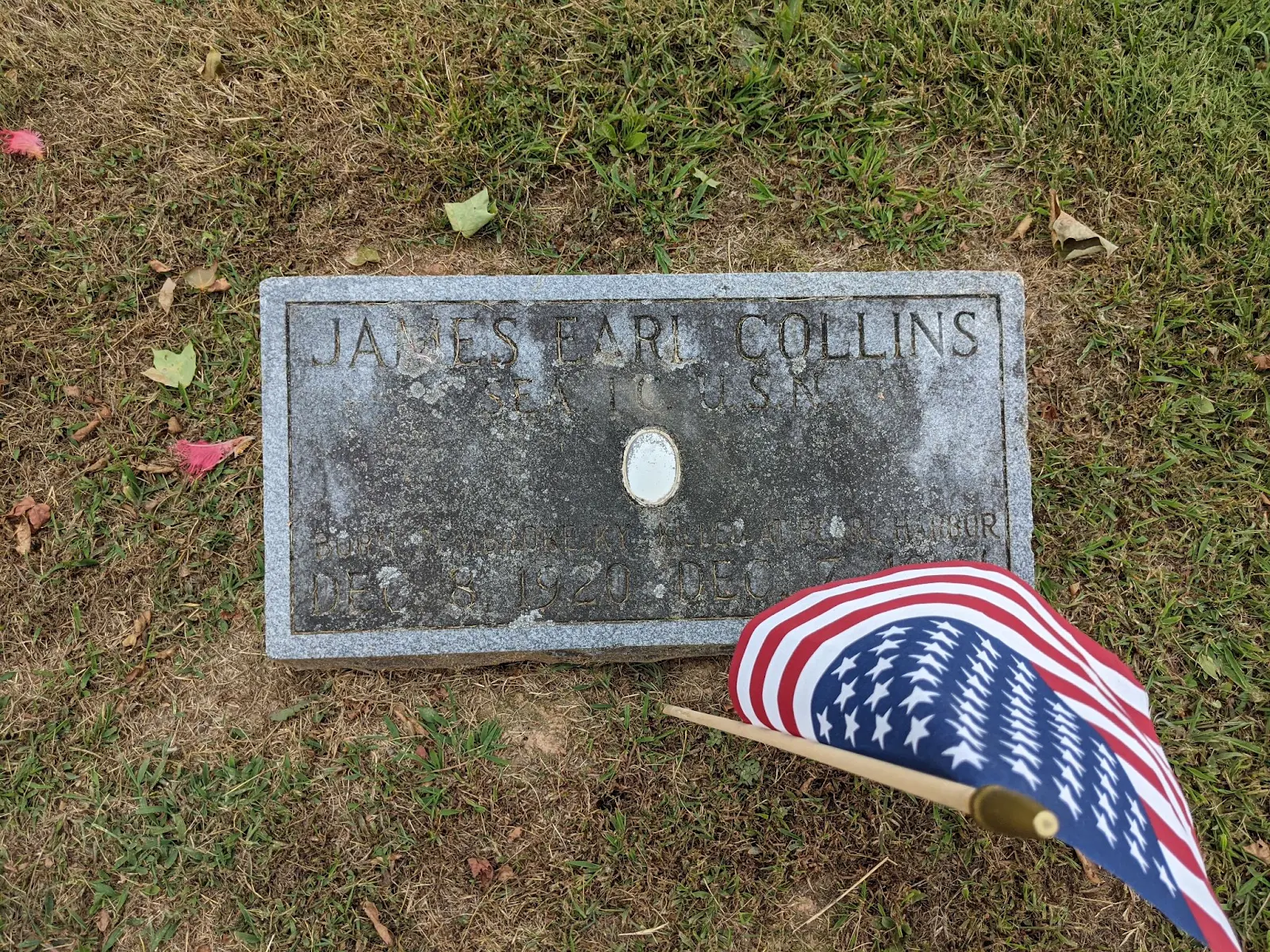
As I examined the other headstones near Earl’s, I saw his wife Clara next to him.  Next to Clara was their son James Earl Collins.   

Jimmie’s tombstone indicated he was born 8 December 1920 and died on 7 December 1941, just one day short of his 21st birthday.   7 December 1941 is a famous date in American history with it being the attack by Japan on the American fleet at Pearl Harbour.   This was the beginning of the involvement of the United States in WWII. James' tombstone indicated that he had died at Pearl Harbour and was aboard the USS Oklahoma.


The USS Oklahoma was a Nevada class battleship, having launched in 1914, later seeing service in WWI.  On the morning of December 7, the USS Oklahoma was docked at Pearl Harbour along with numerous others moored in battleship row.  During the attack, several Japanese torpedoes hit the USS Oklahoma and it was eventually seriously damaged and capsized.  429 crew members perished in the attack, including James Earl Collins.


In a 2007 article in the Kentucky New Era newspaper, family members of Jimmie recounted receiving word of Jimmie’s death with a December 15, 1941 telegram that said “The Navy Department deeply regrets to inform you that your son, James Earl Collins, Seaman First Class, U.S. Navy, was lost in action in the performance of his duty and in service to his country …”

Jimmie was initially buried in a cemetery in Hawaii and on October 28, 1947, he was re-interred at Rosedale Cemetery in Pembroke.


The simple fate of my finding this cemetery on a Sunday afternoon summer drive, finding the square and compass on Jimmie’s dad’s monument, and then learning about Jimmie and his sacrifice for our freedom.  Rest in peace Seaman First Class James Earl “Jimmie” Collins, we honor and remember your sacrifice for all of us.


~GJK


WB Gregory J. Knott is a founding member and Senior Contributor of the Midnight Freemasons blog. He is a Past Master of St. Joseph Lodge No. 970 in St. Joseph (IL) and a plural member of Ogden Lodge No. 754 (IL), Homer Lodge No. 199 (IL) and Naval Lodge No. 4 in Washington, DC. He’s a member of the Scottish Rite, the York Rite, Eastern Star and is the Charter Secretary of the Illini High Twelve Club No. 768 in Champaign-Urbana. He is also a member of ANSAR Shrine (IL) and the Eastern Illinois Council No. 356 Allied Masonic Degrees. Greg serves on the Board of Directors of The Masonic Society and is a member of the Scottish Rite Research Society and The Philathes Society. He is a charter member of a new Illinois Royal Arch Chapter, Admiration Chapter U.D. and serves as its Secretary. Greg is very involved in Boy Scouts—an Eagle Scout himself, he is a member of the National Association of Masonic Scouters. You can contact him at gknott63@gmail.com

Welcome To The Brickyard: A Practical Freemasonry Primer by Matt Gallagher - A Book Review

by Midnight Freemason Emeritus Contributor
Adam Thayer


One of the few positives that has come from quarantine is having more time to read (67 books so far in 2020, not counting comic books and audiobooks), and I’ve been trying to mix in at least one Masonic book a month. This month, I was asked to read Welcome To The Brickyard for review, and I’m always excited to read new Masonic material (sorry Pike!) so I jumped right in.

I should start by explaining that this book really isn’t meant for Freemasons, it’s meant for people who are considering becoming a Freemason, which makes it really tough for me to say how useful it is for the target audience. If you’ve been around the quarries for a few years, most everything in here is going to be old knowledge to you, but it may still be worth having around to give to a potential candidate.

The book starts by discussing what Freemasonry is, if you should consider joining or not, and a basic explanation of some of the rules and requirements for candidates. It then discusses how to research a lodge, including some very helpful information on clandestine lodges, and finishes by walking through the process of petitioning, being interviewed, and how a lodge vote works. This is a very short book (roughly 1 hour long total), which is perfect for new candidates who can easily become overwhelmed.

There are many books that cover the same material as this; it’s very likely your Grand Lodge even offers one. This book does distinguish itself slightly by being funny, which is sorely lacking in a lot of Masonic literature, and depending on the candidate that may reach them better than the normal dry, stodgy pamphlets for candidates. Having said that, some of the jokes are really only understandable after you have taken the degrees, so I imagine they’ll fly over the head of the target audience.

There is some great information in here that isn’t generally covered by this type of book, such as signs to help recognize a clandestine lodge, and what happens if the vote doesn’t go positive for you, and I congratulate the author on including information such as this. It is also written in a conversational style, whereas most candidate books are designed more as lectures or textbooks, and I think that alone makes it useful. Having said that, depending on the individual reading it, that style may be very off-putting, especially when the first two pages cite Star Wars, The Lord Of The Rings, and The Hitchhiker’s Guide To The Galaxy.

So far, this sounds rather negative, which is a shame because this really is a good book to give to a candidate, and I intend to purchase a handful of copies to give out to individuals who show a high enough interest in Freemasonry to be a petitioner. If you’re a lodge secretary, I would recommend getting a copy to check out for yourself, and see if it would be useful for your lodge to hand out as well.

Welcome To The Brickyard can be purchased at www.practicalfreemasonry.com

~AT


A True and Trusty Brother

by Midnight Freemason Contributor
WB Gregory J. Knott

I recently reviewed an Associated Press Poll that was conducted with GFK Public Affairs & Corporate Communications group in a survey of the general American population and their opinions on how much they trust other persons.

The first question “How much of the time do you think you can trust the government in Washington to do what is right?” - 81% of the person’s survey said “Only some of the time”.  This was not surprising to me, considering the recent government shut-down, problems with the Obamacare website and just a generally low opinion of those in the Congress.

The survey went onto to ask how much “you trust other people” in various situations.  Here are 3 examples:

·         “People who have access to your medical records…”
  • 50% said “A great deal/quite a bit”
  • 29% said “Just somewhat”
  • 17% said “not too much/not at all”
·         “People who swipe your credit card or debit card when you’re making a purchase
  • 30% said “A great deal/quite a bit”
  • 43% said “Just somewhat”
  • 24% said “not too much/not at all”
·         “People you meet when you are traveling away from home”
  • 19% said “A great deal/quite a bit”
  • 49% said “Just somewhat”
  • 29% said “not too much/not at all”
The last question in particular, gave me pause to think.  What are my interactions like with others I come to meet for the first time?  Do I need to have my guard up all the time?  Should I live in fear and paranoia?  Ronald Reagan was fond of saying “trust, but verify” that I apply often.  But really, only 19% of the US population feels that they can trust others they don’t know?

Our country has been built on trust, but it appears for many that this trust is slipping away.  Have we become too isolated sitting at home behind our computers?  Are your only friends on Facebook? Are they nothing more than an electronic record that you interact with?  Is the store clerk where you shop more likely to be thief than a trustworthy person?

How do the results of the survey compare to our experience as Masonic brothers?  After all when we enter the lodge the first time, it is in the hands of “true and trusty brother”.

My belief is that one of the greatest experiences of our fraternity as you come through the degrees, is learning to put more trust and faith into the one’s guiding you on your path to further light.  After completing the three degrees, you really start to gain an understanding of what this trust in one another means.

The strength of our fraternity is the common bond that we share with one another, the same shared experiences that have transcended the generations, that same trust from one brother to another brother.

At the 2010 National Scout Jamboree I attended a lodge meeting with Scouters and Brother Masons from across the country, under the guidance of Fredericksburg Lodge No. 4 of Fredericksburg, Virginia.

“So that I may work in foreign countries, to work and receive Masters Wages…”  We have all heard these words, but really what do they mean?  In my opinion, it is the ability to visit other lodges, having the privilege to sit in lodge with fellow brothers, men who may be total strangers, but with whom you have an instant trust with, simply because of the common experiences we all share as brother Master Masons.

I am sure we all have stories of making connections with others that began when you discovered each other were masons.  Perhaps you have attended a Masonic funeral for a brother, whom you never had personally met, yet you came because of that shared bond.  You had a conversation with a person whom you nothing in common with except Freemasonry and that led to a deep friendship.
 

One of my personal favorite stories – I was a staff member at the 2010 National Scout Jamboree held at Fort A.P. Hill for the 100th anniversary of the Boy Scouts of America. I was housed in one of the base army barracks. The first day I arrived, I was sitting on my bunk putting things away, when a Scouter whose name was Tom and assigned to the bunk next to me introduced himself and said “I see you’re a sojourner.” Tom had seen that I was wearing a Masonic ring. We instantly had something in common and became great friends. Though we live in different parts of the country, I have kept in contact with him and was able to visit in him at his home in Seattle last year. Three years had passed, but it was like I had just seen him yesterday.

If you question what Freemasonry still has to offer the world and to those individuals who seek out membership within our fraternity, take a moment and consider Freemasonry as the ultimate social network across the world.  Brothers whom have been “pre-screened” before they entered the west gate and have been initiated, passed and raised under the same obligation you took, to be your brother.

In a society that says they are trusting fewer people, isn’t this exactly what we need more of? 
So the next time, you are speaking to a potential candidate on why they might consider joining Freemasonry, talk to them about the trust amongst the brothers.  Trust, the very thing many people say that is lacking in society.  The answer might be right in front of them, Freemasonry.

~GJK


WB Gregory J. Knott is the Past Master of St. Joseph Lodge No. 970 in St. Joseph (IL) and a plural member of Ogden Lodge No. 754 (IL), Homer Lodge No. 199 (IL) and Naval Lodge No. 4 in Washington, DC. He’s a member of the Scottish Rite, the York Rite, Eastern Star and is the Charter Secretary of the Illini High Twelve Club No. 768 in Champaign-Urbana. He is also a member of ANSAR Shrine (IL) and the Eastern Illinois Council No. 356 Allied Masonic Degrees. Greg serves on the Board of Directors of The Masonic Society and is a member of the Scottish Rite Research Society and The Philathes Society. Greg is very involved in Boy Scouts—an Eagle Scout himself, he is a member of the National Association of Masonic Scouters