Showing posts with label adam thayer. Show all posts

How Do You Eat An Elephant?

by Midnight Freemason Emeritus
Adam Thayer, PM


It’s an oft-repeated joke around our lodge: How do you eat an elephant? We tell it to newly made Entered Apprentices when they’re overwhelmed with learning proficiency, etiquette, names, titles, meeting times, and everything that comes with being a new member. We repeat it to the Worshipful Master when he has the inevitable mid-year freak out about how much he still wants to accomplish before the year is over and he is asked to retire to the sidelines. But for the purpose of this article, it’s a phrase that our Temple Board states at every meeting, every gathering, and every working day we hold.

Our Masonic Temple was built in 1934 and was (at the time) a state-of-the-art building. The building was purpose-built for Freemasonry and even includes a hidden room that you can only enter by being lowered into it for the York Rite degrees (shhh, don’t tell anyone, it’s not even on the blueprints). Every aspect of the building was designed for comfort during meetings, for providing a strong impression on candidates during degree work, and for being a family-friendly location for all of the various groups who meet here.

Having said that… our Temple was built in 1934. The walls are horsehair plaster, the oldest electrical is still cotton wrapped, and the years have not always been kind. Maintenance has varied from “we must do everything possible to take care of this building” to “who can we hire to fix this?” to “we can’t afford to fix it, maybe if we don’t look it will stop?”

A few years back, when our building was hemorrhaging money faster than we could replace it, and things were falling apart faster than we could afford to fix them, two enterprising brothers had a “revolutionary” idea – why are we paying someone to do a lot of this work, when we can do it ourselves?

In retrospect, it seems pretty obvious, doesn’t it? Why pay hundreds of dollars a month for lawn maintenance, when we all have lawn mowers, fertilizer spreaders, and access to all of the same types of yard care equipment that the “professionals” have. Sure, it may take us a bit longer because we’re using smaller mowers, smaller spreaders, and nothing that we can ride on, but there’s no reason we can’t spend the time to take care of a property we love so much.

So these two brothers made a plan; Saturday mornings, they would meet up at the building, and work on cleaning up the yard themselves. If anybody else happened to be around and wanted to help, they’d be welcomed with open arms and pointed in a direction to work.

That first year, we saved thousands of dollars on yard care. That same year, we also established a Capital Improvement & Repairs fund, that could be tapped for emergencies… and there are always emergencies.

Once summer was over, and the yard work was done for the year, the brothers (who, by now, were quite more than just two) didn’t want to stop coming down on Saturday mornings and decided to turn their attention to the inside of the building. After all, there were hundreds of little problems that we could fix ourselves, like leaky plumbing, flickering lights, crumbling plaster… Once they really started looking around the building, it became nearly overwhelming how much work had to be done, but how do you eat an elephant?

Over the course of that winter, the tenants of the building started noticing changes. Problems they had complained about for years were getting fixed. Some parts of the building would suddenly become inaccessible for a time as they were shut down for refurbishment. A building that was feeling old and tired was suddenly trying to spring back to life, one small area at a time. Even more importantly, brothers from across the four lodges who call the building home were working together, cooperating, learning, and laughing in the process.

Our building’s Eastern Star chapter noticed it too and wanted to help out, but most of them didn’t feel comfortable doing electrical work on a live circuit while dangling off a wooden ladder 15+ feet in the air (and yes, that HAS happened, don’t tell OSHA), so they turned their focus to the large kitchen and started making breakfast for us while we were working. I want to be very clear that they VOLUNTEERED for this, at no point did we ask, but they felt it was the best way they could contribute to the work, and we are incredibly grateful to Electa Chapter #8 for providing us excellent food every week while we’re working.

Within a few years, what began as two guys trying to save us a bit of money on yard maintenance has turned into a rotating team of twenty to thirty brothers and sisters who will come in for various projects, great fellowship, and amazing breakfasts. On any given Saturday, you may find one or two guys ripping into some plumbing issue, while another small team is repairing plaster and repainting, another group is cleaning up woodwork and yet another group is outside working on a pavement issue. If you come down, you will be put to work, and you may end up heading up a project if you are particularly good at something.

My own experience has been so varied I don’t even know where to begin. When I was added as a representative to the Temple Board, they immediately made me the IT Director because I have some (very VERY limited) experience with it, and have tasked me with projects as varied as covering the entire building with WiFi, to rewiring the lighting to be smart accessible, to installing security cameras, and my current project of putting speaker systems and Bluetooth receivers into both of our lodge rooms so people can hear better. I have learned how to plaster from Don, an 86-year-old man who is very active in the Eastern Star but has just become active in the lodge over the past few years because he made so many friends while working. I learned maintenance of our aging boiler system from Matt, a 49-year-old man who constantly surprises me with the depth of his knowledge of obscure things. I’ve learned yard maintenance from Joe, electrical from Mike, and painting from Lynn, and what we don’t know we learn and teach each other. More importantly, we’ve all learned better teamwork and leadership, which we take back to our lodges and chapters to improve them as well.

The Capital Improvements fund has come in handy more than once when we’ve had to replace air conditioners, lay new carpeting, and hire other similar projects that were just too big for experience and time to handle. We’ve gone from passing the hat each month to having an investment manager working to tell us the best timing to take on big new projects.

So why am I telling you all of this? Is it just to brag about how amazing things are going for us, and make you wish you were us too? Of course not, although I am very proud of what we’ve accomplished. It’s to teach you something very important that you can use in your own lodge: how do you eat an elephant? Nothing we have done is unique, or requires much knowledge beyond “Alexa, how do I replace a sink?”

Think of the projects your lodge would like to accomplish. It could be building-related like what I’ve listed above, but it could easily be “have more active members” or “be visible in the public” or “add education to every meeting”. Regardless of the project, if it’s worth doing it should seem overwhelming and impossible to accomplish. As an easy example, take “have more active members”; what are you going to give these members to do to be active? Where are you going to get them? If you bring in new members, you’re going to need people who can do all of the degree work, mentors to work with them, food and drink, and time. When you write down everything that you’ll need to have in place to make it happen, you should be freaked out by it, and if you aren’t… set your sights higher.

Or maybe you’re looking at something more personal, like learning a new lecture, weight loss, or quitting smoking. How about building up your skills to earn a promotion at work? Buying a house? It’s time for you to look inward and begin asking yourself the big questions: who are you and what do you want? To quote every meeting of salespeople I’ve ever sat through, find out the why and no how will stop you.

Whatever you’re looking at accomplishing, I know you can do it, but you have to start. Remember: two guys who said “we can mow the yard ourselves” have now, over the years we’ve been working, saved us hundreds of thousands of dollars by doing it ourselves, have taught dozens of men new skills, and forged friendships across lodges that barely talked to each other before even though we were in THE SAME BUILDING.

Hundreds of thousands of Entered Apprentices over history have left their first degree thinking “I’ll never learn all of this” and gone on to do amazing things in Freemasonry. Thousands of new Worshipful Masters have sat down with a plan of what they’d like to get done, and believed they could never do it all, while going on to bring massive improvements across their lodge, and I bet if we were to sit down with some Grand Masters they would tell you the same thing.

One of those two men I told you about is now turning his eye on our York Rite, being able to do all of the degree work ourselves without needing to send our brothers to a festival, and I have zero doubt that he will accomplish it. I know I’ll be there helping in any way I can, which gives us two, and that’s enough to make massive changes, especially when we start with something small, like “Let’s get a team together who can do the Mark Master degree”. I fully expect that if you check back with us in a few years, you’ll find a fully functioning degree team running all of the York Rite degrees and orders in-house.

In the meantime, you’ll still find us on Saturday mornings, repairing plaster, repainting decades-old paint, and discussing new projects we’d like to tackle. In between all of the laughing, teaching, and occasional swearing at some unexpected problem, you might just hear some ritual practice happening too. Quite a few newer members have been able to pass their proficiency because of what they’ve learned while we were pulling new electrical lines.

But I really should at least tell you the rest of the joke… How do you eat an elephant? One bite at a time.

~AT

From the Archives: Day By Day, The Masonic Way: Disappointment

by Midnight Freemason Contributor
WB Adam Thayer


Brethren, as I look back over the pieces I’ve written in the past few years, I see many things I’m very proud of. There were a great many papers on various topics, full of emotion and passion, but what I’ve found missing is what I would consider “solid” education, that is, a practical application of the instructions we are taught in our three degrees. Over the next series of papers I write, I plan to address that issue. I hope to be able to provide some solid teachings, and learn something myself in the process!

Many minds far greater than my own have written examinations of the symbols that are presented, and I promise that if you spend the time pouring over their writings you will find it to be a rewarding and enriching pursuit. Instead of retreading the words of our forefathers, I hope to break new ground by discussing the issues that face our brothers today. I won’t even pretend to be doing this for entirely noble reasons; to a degree (if you’ll excuse the pun), this is my attempt to deal with these issues in my own life and, through that process, find peace for myself.

Tonight, the issue that is most heavy on my mind is that of disappointment. Disappointment comes in many forms; maybe you didn’t get the promotion you deserved, or your team ended their season with a 6-7 record (I’m looking at you Cornhuskers), or maybe your evening just didn’t go the way you had hoped it would. Disappointment is a common human condition, however to dismiss it so easily is to downplay how absolutely crushing the experience can be when it occurs.

At its core, disappointment comes from reality not living up to our expectations. Perhaps our expectations were set too high, perhaps we ignored the reality of our situation, or perhaps the world is a complex, sometimes cruel place where things don’t go the way they should. Whatever the real reason, disappointment taken to an extreme can lead to severe anxiety issues, with sufferers going out of their way to avoid any risk that may lead to disappointment.

King Solomon knew disappointment; even with all of his accomplishments he saw failure after crushing failure, leading him to say “I surveyed all that my hands had done and what I had toiled to achieve, everything was meaningless, a chasing after the wind.” King Solomon definitely had a flair for the melodramatic, however I believe we can all identify with the sentiment: after all of our hard work and effort, when everything comes crashing down around us, what is the point of our labors?

When faced with disappointment, my mind first goes to thoughts of the mosaic pavement. Being the representative of human existence, it is necessarily equally checkered with both white and black tiles, which we are taught is emblematical of the good and evil in our lives. It could also be said to represent our victories and our defeats, our joys and our disappointments, which equal out in the long run of our lives.

A man much wiser (and significantly cheesier than I) once stated that walking the mosaic pavement is very hard on the feet. This is most especially true when we’re face to face with our disappointments.

There is an insidious danger in disappointment: often, we turn to our vices to help ease the pain. Solomon turned to both wine and women to make him forget the suffering crush of his disappointments, and it worked… for a while. However, he learned what we all must learn: the harder you try to escape reality, the more painful it is when it reasserts itself. After spending many drunken years amassing a fortune filled with every pleasure money could buy, he found himself more emotionally destitute than he began.

Truly dealing with our disappointments head-on takes courage, but it also takes a humble spirit. It begins with accepting what has happened, which many of us have a very difficult time with. It also takes time, something that I myself have an issue with; we want everything fixed right now, not at some magical later date. Finally, it takes a willingness to learn from the situation, to prepare us for future storms.

Here’s a little secret from me to you: life is full of disappointments. Rather than letting them destroy us, we have the opportunity to learn and grow from them. If the human life is an alchemical process, then disappointment is the process which transforms our rough ashlars into perfect ashlars.

I hope you can learn to channel your disappointments into your passion; for me, that passion is writing, and the large number of papers that have been posted since my first guest post nearly two years ago is a testament to the disappointments in my life. For one of my good friends, he pours his disappointment into music, and has constantly improved his talent to a near professional level. Whatever your passion is, I encourage you to pour all of your frustrations into it; let them fuel you as you strive to become ever greater.

I won’t leave you with a banal platitude like “when one door closes, another one opens” (in the words of Bill Murray, just open the door, that’s how doors work), but I will tell you that I have learned this: life is like a beautiful jigsaw puzzle. You can’t start to make sense of it until it has all fallen apart.

~AT

WB. Bro. Adam Thayer is the Senior Warden of Lancaster Lodge No. 54 in Lincoln (NE) and a past master of Oliver Lodge No. 38 in Seward (NE). He’s an active member in the Knights of Saint Andrew, and on occasion remembers to visit the Scottish and York Rites as well. He continues to be reappointed to the Grand Lodge of Nebraska Education Committee, and serves with fervency and zeal. He is a sub-host on The Whence Came You podcast, and may be reached at adam@wcypodcast.com. He will not help you get your whites whiter or your brights brighter, but he does enjoy conversing with brothers from around the world!

This Is Not An Education Piece

by Midnight Freemason Emeritus
Adam Thayer, PM


My favorite piece of art… is that weird? Do normal people have favorite pieces of art? I hear about my friends talking about favorite movies, favorite songs, and even occasionally someone will mention a favorite book, but nobody seems to talk about art.

My favorite piece of art is an oil on canvas painted by the Belgian surrealist Rene Magritte. After working as a commercial artist for a number of years, he painted a picture of a large wooden pipe, and underneath wrote “Ceci n’est pas une pipe”, or literally “This is not a pipe”. To tie it all together, he titled the painting The Treachery Of Images, to remind us of the dangers that images can pose.

Years later, when he was questioned about the image, he replied firmly that what he wrote was correct; it was not a pipe, it was a representation of a pipe. You couldn’t put tobacco into it, you couldn’t light it, because it was only an image of a pipe. In fact, he went on to say “if I had written on my picture ‘This is a pipe’ I’d have been lying!”

As a writer, it reminds me of Alfred Korzybski stating “The map is not the territory - the word is not the thing”. It’s a constant reminder that words, no matter how beautifully written, are still just representations of the actual thing. I could spend paragraphs detailing Magritte’s beautiful pipe – which is, I remind you, not a pipe – the fantastic shine of the bowl and stem, the glow of it against the golden background, the thin, almost fragile lettering underneath, and yet that description is still a pale comparison to seeing the actual picture in person.

I imagine many of us feel that way about our degrees; I can tell you about the nerves I experienced leading up to it, the scent of the room, the feeling when I was first brought to light… but none of this can live up to having been there, in that room, in my skin. Yet, in the act of describing it, I remember that night ten years ago, as if I was still there.

Neither can I put the sound of a brother’s voice in your head the way I hear it, clear as day, whenever I get up to give what I still consider to be “his” lecture. The best I can give is a representation of it, kind, loving, yet firm in his demand that I never let that lecture be read from the book or be performed without feeling.

Our symbols are like that too; while you may have some of the symbols as physical representations (doesn’t every lodge have a square and compass?), they are still just that – representations. The compass in our lodges, for instance, is generally not a compass one could actually use to circumscribe a true circle. What’s more, I’ve yet to find a lodge with an actual beehive, although I do think selling Masonic Honey sounds much more interesting than flipping pancakes.

The Treachery Of Images is a fantastic reminder of the place our symbols belong in Masonry – as mental placeholders for complex teachings and morality instruction. The symbols themselves only contain the meanings we put into them, and as such should not be deified in and of themselves.

Of course, the phrase “The word is not the thing” should bring a special meaning to the Master Mason, which I will point out for those who are inclined to ponder without expounding the substitution principle to the uninitiated.

So Adam, I hear you thinking, what’s your point? Has all of this been a rambling opportunity for you to have an excuse to write about your favorite piece of art? Yes, obviously. Perhaps I should have titled this “The Treachery Of Education” and include the disclaimer “Ce n’est pas une conference educative”.

Perhaps I could trick you into reading paragraph upon paragraph, expecting to find some hidden nugget of wisdom that I subtly snuck in but that you are starting to doubt is in there. Perhaps I already have.

Perhaps the point of all Masonic Education really shouldn’t be to teach necessarily, but to encourage you to think and discover meaning for yourself. Then again, to paraphrase Magritte, this is not a Masonic Education piece. Unless, of course, it was.

~Adam Thayer

Welcome To The Brickyard: A Practical Freemasonry Primer by Matt Gallagher - A Book Review

by Midnight Freemason Emeritus Contributor
Adam Thayer


One of the few positives that has come from quarantine is having more time to read (67 books so far in 2020, not counting comic books and audiobooks), and I’ve been trying to mix in at least one Masonic book a month. This month, I was asked to read Welcome To The Brickyard for review, and I’m always excited to read new Masonic material (sorry Pike!) so I jumped right in.

I should start by explaining that this book really isn’t meant for Freemasons, it’s meant for people who are considering becoming a Freemason, which makes it really tough for me to say how useful it is for the target audience. If you’ve been around the quarries for a few years, most everything in here is going to be old knowledge to you, but it may still be worth having around to give to a potential candidate.

The book starts by discussing what Freemasonry is, if you should consider joining or not, and a basic explanation of some of the rules and requirements for candidates. It then discusses how to research a lodge, including some very helpful information on clandestine lodges, and finishes by walking through the process of petitioning, being interviewed, and how a lodge vote works. This is a very short book (roughly 1 hour long total), which is perfect for new candidates who can easily become overwhelmed.

There are many books that cover the same material as this; it’s very likely your Grand Lodge even offers one. This book does distinguish itself slightly by being funny, which is sorely lacking in a lot of Masonic literature, and depending on the candidate that may reach them better than the normal dry, stodgy pamphlets for candidates. Having said that, some of the jokes are really only understandable after you have taken the degrees, so I imagine they’ll fly over the head of the target audience.

There is some great information in here that isn’t generally covered by this type of book, such as signs to help recognize a clandestine lodge, and what happens if the vote doesn’t go positive for you, and I congratulate the author on including information such as this. It is also written in a conversational style, whereas most candidate books are designed more as lectures or textbooks, and I think that alone makes it useful. Having said that, depending on the individual reading it, that style may be very off-putting, especially when the first two pages cite Star Wars, The Lord Of The Rings, and The Hitchhiker’s Guide To The Galaxy.

So far, this sounds rather negative, which is a shame because this really is a good book to give to a candidate, and I intend to purchase a handful of copies to give out to individuals who show a high enough interest in Freemasonry to be a petitioner. If you’re a lodge secretary, I would recommend getting a copy to check out for yourself, and see if it would be useful for your lodge to hand out as well.

Welcome To The Brickyard can be purchased at www.practicalfreemasonry.com

~AT


Book Review: Loge Liberté cherié: A Light In The Darkness by Alexander P. Herbert

by Midnight Freemason Emeritus Contributor
WB Adam Thayer

Click the image above to check out the book. 
One of the great joys in my Masonic journey is getting to read new research materials for review. I’m often contacted by authors who are releasing new books with the opportunity to read their work in exchange for an honest review. As someone who reads an obscene amount, I always jump at the chance.

I received a copy of B. Herbert’s history of a Masonic Lodge formed inside a concentration camp with a lot of excitement, as this era of Freemasonry has always been an interest of mine. Unfortunately, I stupidly took my copy to my office, intending to read it on my lunch breaks, and shortly after, our office shut down due to the current pandemic. All of this is a very long-winded explanation to apologize to B. Herbert for taking so long to review this great book!

A Light In The Darkness covers the events surrounding the formation of Loge Liberté chérie, a Masonic Lodge that formed and met inside of a concentration camp. Due to the highly illegal nature of the Lodge, records are quite scarce, making this book the most complete history we will likely have available.

The book begins with a brief explanation of the cultural views of Freemasonry during World War II, a topic that is generally glossed over in most history books. Specifically, the book gets into a pretty thorough discussion of the laws and edicts that were passed forbidding different aspects of the Craft, which culminated in Freemasons being arrested and put in concentration camps as political prisoners.

It continues by examining the three Catholic priests who served as unofficial Tilers for the Lodge, by keeping an eye out for Nazi guards patrolling the camp during Lodge meetings. This section definitely provides an interesting counterpoint to the typical “Catholics hate the Freemasons” narrative that we usually see in history, and shows that good people continue to do good deeds, even in the darkest times.

The book then hits the “meat” of the topic: the formation of Loge Liberté chérie the business the Lodge was able to perform within the camp, and the artisans they worked with to procure supplies, such as a tracing board. Unfortunately, as previously stated, while this is the most exciting part of the book, it is also the most sparse; even in the best of times, Lodge records can be difficult to locate, and since this specific Lodge was formed in extreme secrecy, the records are nearly non-existent. Most of the history we have available is from the three brothers who survived to the end of World War II, and from others who were in the camp with them.

We finish with a brief examination of the troubles faced by the Brothers of the Lodge post World War II to gain official recognition, as the Lodge was formed clandestinely under extreme circumstances. It is interesting to note that while the Lodge first formed in 1943, and the war ended in 1945, the Lodge was not granted official recognition and a charter until 1987.

This book itself is pretty short and can be finished in an afternoon, however, considering the events it is examining took place over a short time that is not a detriment. It would have been easy for the author to be tempted to pad out the book by adding superfluous materials, and a credit to him that he did not.

The book is also filled with photos that provide greater knowledge of the individuals involved, the layout of the camp and the Lodge within it, and the supplies they had available. These are a welcome addition, as it enriches the experience by helping provide a connection to the text. Many history books leave this material out, and they end up being dry text, so it was good to see how many photos the author was able to include.

I would also like to thank the author for the tremendous amount of research that went into this book; as almost none of the source materials were in English, he had to not only compile the information presented but also translate it, and then fit it into the overall narrative. I can only imagine the hundreds of hours of research that went into putting this together, and it is evident that the author knew the material very well by the time he was finished.

I would highly recommend this book to anyone with interest in Masonic history, as it provides a precious window into a Lodge that would easily have been forgotten otherwise. You can pick up a physical copy from Amazon or Barnes and Noble for $10 US; unfortunately, due to rights issues for the images, a digital copy is not currently available.


~AT

Remembering our Past Masters - Revisited

by Midnight Freemason Contributor
WB Adam Thayer


Last year at this time, I was lucky enough to receive permission to share my lodge’s Past Master’s Remembrance ceremony with you HERE. At the time, I wrote it from the viewpoint of the Master of the lodge, with more of a cold, analytical point of view, so that I could provide you with the script and staging instructions to hold your own ceremony. Now I’m the junior Past Master in my lodge, and would like to discuss the why, instead of the how.

As you read in the linked article, the junior Past Master is responsible for the planning and execution of the Past Master’s Remembrance ceremony. They arrange the dinner, manage the printing and mailing of the invitations, the programs, and present the speech given. This is considered their last official act as Worshipful Master, and to say that a lot is riding on it is an understatement.

Heading into the day of the event, I worked hard (under the direction of our long-suffering Tiler) to get the room set up properly and test the projector to be certain that all of the deceased PM pictures would appear in the proper order. We also arranged to have an Oriental Chair draped at the entrance, to further drive home our reason for being there. Before walking out of the lodge, we cranked the air conditioner to as low as it would go, in the hopes that the room would be cooled off in time for the ceremony. (Author’s note, this is called foreshadowing, don’t forget that we did this)

I mailed the invitations at the end of April, which should have provided plenty of time for them to arrive, however a number of people still haven’t received them as of writing this article. We are experiencing a similar issue with donation requests that are being sent out from one of the foundations that I work with. As an aside, if anyone knows a solution to getting first class mail delivered reliably, please email me at adam@wcypodcast.com and let me know!

Because many people didn’t receive the invite, turnout was significantly lower than expected, especially among the Past Masters. Out of the 31 living Past Masters in our lodge, there were only 7 in attendance (including myself), and attendance rates among the members and the widows was very similar. Very important lesson learned: while mail is good, you can’t put your entire hopes on it arriving. If I could advise future junior Past Masters planning this event, I would tell them to take a multi prong approach, by mailing the invite, then following up via email or phone.

The dinner itself was good, if a bit overpriced by the caterer, and I fear I may have driven our secretary into a minor mental breakdown when he saw the bill. One of the only positives that came from such a low turnout is that we’ve enough leftovers for our business meeting next week, and so one meal was stretched into two. I know, I’m stretching a bit to justify the cost. Very important lesson learned: try not to spring a large surprise bill on the person who will be writing the check.

After dinner, we retired to our lodge room for the ceremony itself, and I have to say that after having been out of the East for so many months it was a bit nerve-wracking being back up there. Even though I had practiced, and checked to make sure that everything would run smoothly, I was still back to being as nervous as I was at my first meeting as Master.

Ten minutes before the start of the ceremony, I returned to the lodge room, and turned the air conditioner off. Our air conditioner is an older system, and in addition to being slow to respond to changes, it is incredibly noisy. It is also incredibly complicated, as it has independent controls in three different rooms, and if they aren’t all set correctly it won’t turn on… or, as the case was last night, turn back off! Even though I was nearly shouting through most of the ceremony, part of the room couldn’t hear a word I said (except, of course, for when I mispronounced a name). Very important lesson learned: no matter how hard you try, some things will always be outside of your control, and you just have to learn to live with that.

The ceremony itself was as beautiful as always, as the original author had a way with words that I can only aspire to. I have been lucky that, through my Masonic journey, I have been forced into public speaking at every turn, and so I was able to actually look at the people gathered there instead of “talking to the podium” as I’ve seen done so often. More importantly, for me, is that I was able to watch as each of the 104 carnations was laid, one for each deceased Past Master, and so able to honor them by remembering them, and in this I learned the most important lesson: never forget the people behind the ceremony. It’s so easy to get caught up in worrying about all of the details that we forget the reason we hold the ceremony to begin with.

After the ceremony it was time for tearing down and cleaning up, presenting carnations to the widows, and thanking the current Worshipful Master for allowing me to have his lodge for the evening. Of course, we also had to go out for pie afterwards (for more information on the importance of pie, see my article HERE), and everyone talked about how great the evening was, but for me nothing will top the honor of getting to honor the 104 men who faithfully served our lodge in life before laying down their working tools and attaining peace at the last.

~AT

WB Adam Thayer is a grumpy-ish past master of Oliver #38 in Seward, NE and Lancaster #54 in Lincoln, NE. He continues to be reappointed to the Grand Lodge of Nebraska Education Committee, as well as being an occasional host on the Whence Came You Podcast. He may be reached directly at adam@wcypodcast.com or summoned by placing a certain number of lapel pins in a special pattern around a petition for an appendant body.

The Three Apprentices: An Experiment - Chapter Two

by Midnight Freemason Contributor
WB Adam Thayer


This is the second article in a series about a lifelong mentoring experiment I am conducting. Before continuing, you may wish to go back and read the first article (creatively titled “The Three Apprentices: An Experiment - Chapter One”), available HERE.

“Why do you think we say these specific words here?”

When I was doing my individual ritual proficiency examination with my lodge’s Deputy Grand Custodian, those were words that struck fear into my heart. From observing him examine other individuals and lodges, I had found that he had the absolute worst timing with that question; whenever someone was really in the zone with the ritual, he would interrupt and ask why we did something.

At first, it appears that he asks it randomly, but in reality he times it intentionally, but not maliciously. Real degrees often have unscripted interruptions, and knowing how to recover from them seamlessly is an important part of providing the best degree for the candidate.

In addition, the Deputy Grand Custodian who works with my lodge is incredibly intelligent and well learned, and while I always dreaded the interruption, I also knew that I was going to learn a part of the meaning to our ritual that most people wouldn’t even know existed. In fact, it would not be an exaggeration to state that he has inspired many of the articles I have written, with that simple question “Why do we do it this way?”

Neil and I have been working very heavily on his Entered Apprentice proficiency. He received his degree back in the middle of February, and we have been meeting regularly at least once a week, and sometimes up to three times a week. Our meetings usually start with catching up on anything interesting he has found, going over different bits and pieces from the EA ritual, then we’ll spend the next hour working through the Questions and Answers lecture.

I cannot describe in words the incredible pride that comes with mentoring a brother through the degree work. Over the past few months, I’ve watched him go from struggling to read the words from paper to being able to recite the ritual back with very few mistakes, and seeing him begin to not only understand the words, but more importantly to analyze their meaning.

“Why do we say this here?”

It’s a question Neil and I have discussed quite a bit as well. As he has become more comfortable with reciting the ritual, we’ve started to analyze what the different portions of it were intended to teach him, and how he can apply them in his own life.

I have attempted to not impart my own Masonic biases on him, and to let him form his own opinion as to the meanings behind the words. I’m not entirely certain how successful I’ve been at that, but I can also say that Neil is highly intelligent, and I don’t believe that I could make him believe something against his will even if I tried. He has already discovered, entirely on his own, some meanings in the ritual that took me a few years to catch on to, and I see a time coming soon where he is teaching me more than I am teaching him!

With any experiment, it’s important to objectively judge results, and I’m afraid that in this I will fail miserably. In addition to being my apprentice, Neil has quickly become a trusted friend, and I cannot help but view his progress through that lens.

Although, isn’t that, by itself, an indication of the success of the experiment? The original stated intention was to minimize the risk of losing a new candidate by doing the exact opposite of what we normally do with our candidates, and I have no doubt that Neil will continue to be very active long past his Master Mason degree.

By the time this article releases, hopefully we will have finished conferring the Fellowcraft degree, and Neil and I will be deep into the esoteric meanings behind the middle chamber, which I’m highly looking forward to seeing his opinion on.

~AT

WB Adam Thayer is a grumpy-ish past master of Oliver #38 in Seward, NE and Lancaster #54 in Lincoln, NE. He continues to be reappointed to the Grand Lodge of Nebraska Education Committee, as well as being an occasional host on the Whence Came You Podcast. He may be reached directly at adam@wcypodcast.com or summoned by placing a certain number of lapel pins in a special pattern around a petition for an appendant body.

The Three Apprentices: An Experiment- Chapter One

by Midnight Freemason Contributor
WB Adam Thayer


I recently took the first of my three apprentices. That is probably a bit of an obscure statement to most people, so please allow me to explain.

In the Schaw Statutes, which laid out some basic rules for Operative Masons, and set the groundwork for the transition to Speculative Masonry, there is a rule that is often overlooked, and I have only very rarely heard it discussed. It reads, “No master shall take more than three 'prentices in his lifetime, without the special consent of all the wardens, deacons, and masters of the sheriffdom in which the to-be-received 'prentice resides.”

Of course, in terms of Operative Masonry, this statute makes great logical sense: to protect the reputation and income stream of the order. If anyone could become a stonemason, the supply would quickly exceed the demand, and income for the working masons would quickly drop. Even worse, if someone less than reputable performed shoddy work at an inflated price, all stonemasons would suffer for it; for anyone needing a modern example, consider the auto mechanic. While most mechanics are good, honest people making a living, there are some who use their specialized knowledge to rob from those who don’t know any better, and so in the eyes of the general public (and especially stand up comics), all mechanics are out to “rip us off.”

The Schaw Statutes go on to further lay out some rules for apprenticeships, such as the term (fourteen years total, which may be abridged by a vote of the lodge), how the Master should care for the apprentice (he can’t, for instance, sell him to another Master), and some fines for breaking these rules (40 pounds, or approximately $11,234 in today’s money, if the University of Wyoming can be trusted to calculate the inflation properly). While this information is definitely interesting from a historical perspective, and is worth your time to read over, it doesn’t directly pertain to the topic of this paper and can safely be ignored for now.

Is there a value to following this same guideline today? If you’ve read any of my other papers, you know I don’t ask a rhetorical question like that unless I plan to address it in a way that supports my intention for writing the paper. But first, as is usually my habit, I’m going to go on a long winded rant that will describe the problem in enough detail that even those unfamiliar with the situation can understand why the solution is important.

In my few years of Masonry, I have seen many men get rushed into Masonry, and then, for various reasons, leave again. Some of them went on to be a part of the higher grades of Masonry, such as the various Rites, some were absorbed directly into the Shrine, but many of them just disappeared, never to be heard from again.

Now, I know we’ve all talked about the “membership issue” from many different thought processes (I personally like “we’re not declining, we’re refining”), but this is one angle that I haven’t seen discussed yet: what a WASTE that system is.

It’s a waste of a man who, if given the proper guidance and training, may have been an amazing asset to the lodge. It also means that if he ever does receive what he came to us for (improvement of self through esoteric knowledge), it won’t be from us, and we are supposed to be the experts on the topic!

Equally bad, it’s a waste of our time, and I can’t speak for you, but my time is severely limited. In addition to the time spent on the degrees themselves, there is the time the lodge spends practicing in preparation, and the time each brother spends individually practicing to give the candidate the best degree possible. (At least, I really HOPE you are, and if you need any motivation as to why you should be giving the best degree possible, go read my paper titled “On The Membership Issue or: Why The Troma Rules of Products Doesn’t Apply to Freemasonry”) That time is time that I could use for a dozen other things, like writing papers, or playing with my daughter. I definitely don’t want to waste it on someone who isn’t going to stick around.

“Someone who isn’t going to stick around”... That sentence sounds so much like I’m blaming the candidate for leaving us, but the truth is, it’s very rarely his fault for leaving, it’s almost always our fault for not keeping him. Shame on us.

So, what is the solution?

I truly believe that most men today come to Masonry to receive deeper learning that will help them improve themselves, even if they can’t put it into words, and all throughout the degree process we work directly with them, teaching them some basics, and promising they will learn everything once they have completed their degrees. Once they have finished their degrees, we tell them “Well, you get out of it what you put into it” and then turn our focus to the next candidate. What message does that send our new brothers? “Hey, we got you in, now you’re not important to us any more.”

Some of the smarter lodges will assign a mentor, who will work one-on-one with the candidate during the whole degree process, to help him memorize the ritual work he will have to recite, and even answering the occasional question, if it isn’t too complicated. This man will continue to work with the new brother until after he has completed his Master’s proficiency, but will most likely move on to the next as soon as that is finished.

To paraphrase Andrew Ryan, I reject those answers; instead I choose something different. I choose the impossible. I choose apprenticeship.

It may seem that taking an apprentice isn’t really that different from being a mentor, however there are some key differences. “Apprentice” implies first that he will be learning everything I know to teach him, not just the memory work for his proficiency. Now, I’ll grant that I know only a small portion of everything there is to know Masonically, but it is my hope that in the process of teaching, I’ll also be learning from him, and so we both become better Masons for it!

“Apprentice” also implies a longer process; the Schaw Statute recommends seven years of teaching followed by seven years of practicing before he can move from an apprentice to a fellow of the craft. Unfortunately, I don’t believe our Grand Lodge would be ok with me holding a man as an EA for seven years, and even if they did, I don’t know that I have enough to teach on a single degree for that long. Instead of seven years, let’s decide on “longer than the one month per degree that most men experience.”

Since (per the Schaw Statute) we are limited to three apprentices in a lifetime, I must be significantly pickier about who I choose for this process, as making a mistake in the selection means a large waste of time and resources, and it also means that someone who would benefit more from it is missing out. Note, I do plan to stick to this very strictly, unless (as Schaw later allows for) there is an extremely extenuating circumstance, in which case I will seek guidance from my three apprentices as to how they believe I should proceed. I will be turning to them instead of to all the masters and wardens, because I have no idea how large my sheriffdom is.

Finally, “apprentice” implies a significantly more intimate connection than a mentorship under the current process achieves. It is my hope that by the end of the apprenticeship, his family and my family have become friends, and that he and I are truly like brothers because of our shared experiences studying. In short, I hope that we have become what our founders envisioned us to be.

There are still a lot of unanswered questions, things I’m not quite sure how to tackle, but I’m hoping that once we get started it will become an organic process. I also imagine there will be quite a lot of adjusting course as we go along, so I’m trying to keep my plans flexible. As I said in the title, this is an experiment. Hopefully, the results will inspire some of you to try it as well, and the details of the process will help you avoid some of my pitfalls.

So, as I said at the start, I’ve taken the first of my three apprentices. His name is Neil, and over the next year or so you will get to experience his journey along with him, both through my observations (again, remember this is an experiment), and through his own words. His Entered Apprentice degree is in the very near future, so we will have quite a lot to talk about in the near future!
Until then.

WB Adam Thayer is a grumpy-ish past master of Oliver #38 in Seward, NE and Lancaster #54 in Lincoln, NE. He continues to be reappointed to the Grand Lodge of Nebraska Education Committee, as well as being an occasional host on the Whence Came You Podcast. He may be reached directly at adam@wcypodcast.com or summoned by placing a certain number of lapel pins in a special pattern around a petition for an appendant body.

The Weight of a Masonic Ring

by Midnight Freemason Contributor
WB Adam Thayer


This evening, I had the pleasure of editing a paper for fellow Midnight Freemason Bill Hosler, which discussed the history of his Masonic ring, and it got me thinking about my own ring, and the cost associated with it. Everything in life has what economists call an opportunity cost; that is, what is given up for what you receive. The easiest example is buying a cup of coffee: the opportunity cost is the money you pay to receive that life-giving goodness.

Our rings come with an opportunity cost. Of course, it’s easy to give a dollar amount to my ring (it wasn’t very expensive, but in case my wife is reading I’m not going to admit exactly how much), but it has cost me much more than just the money I spent on the afternoon I bought it.

Over the years, my ring has cost me quite a lot in dues payments to different lodges and other bodies. My ring has obviously cost me many evenings away from my family. It has cost me thousands of hours spent studying ritual work when I would have much rather been rotting my brain with television. It’s cost me biting my tongue when some idiot at the grocery store is annoying me, because if I said what I wanted to everybody would know that it was a Freemason who said it. It has forced me to re-examine who I am, and to make changes for who I hope to be one day. Without exaggerating, it literally cost my old identity, who had to die to make room for who I am becoming.

When I first bought this ring, if I had known the cost that came with it, would I have still purchased it? Since the ring is just a symbol, a reminder to me of my obligation, I suppose the question would be better worded thusly: when I first signed my petition, if I had known the cost that came with it, would I still have petitioned? I believe I would have, because the opportunity cost is far outweighed by the benefits that came from it, however I must admit that if the fraternity had been pitched to me in that way I would have definitely paused a bit longer before signing my name.

Even more noteworthy than the cost of my ring is its weight. My Masonic ring weighs 8 grams, according to my kitchen scale, but of course this tidbit of information is only interesting to the most obsessive jewelers among you, and “weight” in this instance is yet another symbol, because the true weight of my ring is unbearably heavy for a man to maintain by himself.

My ring comes with the weight of all of the brothers who came before me; I owe it to them to represent them well to the current generation, and to ensure that the solid foundations that they built are maintained for future generations to enjoy. It is weighed down with an obligation which demands I constantly seek improvement, leaves no room for excuses, and provides for the stiffest of penalties (symbolic though they may be).

I find that often, while I’m writing, I turn to the wisdom of The Beatles, and this instance is no exception; the second side of Abbey Road contains one of my favorite pieces of music, which is nearly sixteen minutes long (even if it’s listed as separate tracks, it’s really one large one), and contains some of the deepest lyrics that they ever wrote. In the middle of this fantastic medley are a few words that come back to haunt me in my darkest hours: boy, you’ve got to carry that weight a long time.

~AT

WB. Bro. Adam Thayer is the Senior Warden of Lancaster Lodge No. 54 in Lincoln (NE) and a past master of Oliver Lodge No. 38 in Seward (NE). He’s an active member in the Knights of Saint Andrew, and on occasion remembers to visit the Scottish and York Rites as well. He continues to be reappointed to the Grand Lodge of Nebraska Education Committee, and serves with fervency and zeal. He is a sub-host on The Whence Came You podcast, and may be reached at adam@wcypodcast.com. He will not help you get your whites whiter or your brights brighter, but he does enjoy conversing with brothers from around the world!

Measured Expectations - A Review of Michael R. Poll's New Book

by Midnight Freemason Contributor
WB Adam Thayer


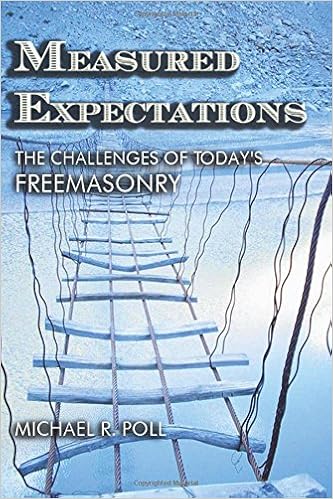
One of the greatest duties I’ve been called for as a writer is to be a book reviewer. Not only does it afford me the opportunity to count my reading time as “work”, but it exposes me to multiple great works that I might otherwise never have discovered. Such is the case with “Measured Expectations: The Challenges of Today’s Freemasonry” by Michael R. Poll, which I only learned of when I was asked to review it.

I have enjoyed Brother Poll’s other works greatly, and specifically his Masonic edition of “Robert’s Rules of Order” has proven an invaluable reference during my time as Worshipful Master. If you have ever read any of his books on philosophy or esotericism, you should have a rudimentary idea of what to expect here.

This book (as with many of Brother Poll’s other books) isn’t necessarily intended to be read start to finish, although you are definitely welcome to do so. Instead, each chapter serves as a short stand alone education piece, suitable for either private reflection or for a supplement to your lodge’s education program. As such, it becomes very difficult to review this as a “book”, and we must instead look at it as a collection of papers sharing the same basic theme.

With any collection such as this, there will be some works that are stronger than others, and some that are more meaningful to you in your current journey than the rest. If I had my way, every single Mason would read the first paper, titled “A Young Man Joins A Masonic Lodge,” before their annual elections. I believe this one paper to be of such high importance to understanding the current problems in Freemasonry that I think it should be distributed as far as possible, and this paper alone is worth the purchase price of the book.

Another paper that I found fascinating had to do with the symbolism and history of the double headed eagle. I would love to see the ideas in this chapter expanded on, as it could almost be a book to itself. My only frustration is that it was much too short, and Brother Poll had to stop the article before really delving deeply into the ideas he brought up.

The remainder of the papers in the book delve into subjects such as music, the history and role of ritual, understanding the culture of different lodges, and a brief examination of the modern Scottish Rite. Conspicuously absent is any discussion of the York Rite; I’m not certain if Brother Poll does not find it an interesting topic, or if he doesn’t feel qualified to discuss it, however I would have loved to see his take on the modern York Rite in the same manner he discusses the Scottish Rite.

“Measured Expectations” is necessarily repetitive at times; as a collection of papers, some themes are touched on in multiple different papers, and each time it is from the standpoint that you did not read any of the previous papers. This isn’t a bad thing, since the intention is to use each chapter by itself, however it is something to be aware of if you choose to read it start to finish as I did.

The intention of this book is to help brothers who are newer to Masonic education find a foot in the door, and it exceeds expectations for that. The topics presented and writing style are all simple enough for a newer Mason (or one who is just finding an interest in learning more) to gain significant insight from, without boring the more experienced Mason. If this book makes you curious to start doing more in-depth research on your own, Brother Poll should consider himself highly successful.

~AT

WB. Adam Thayer is the Senior Warden of Lancaster Lodge No. 54 in Lincoln (NE) and a past master of Oliver Lodge No. 38 in Seward (NE). He’s an active member in the Knights of Saint Andrew, and on occasion remembers to visit the Scottish and York Rites as well. He continues to be reappointed to the Grand Lodge of Nebraska Education Committee, and serves with fervency and zeal. He is a sub-host on The Whence Came You podcast, and may be reached at adam@wcypodcast.com. He will not help you get your whites whiter or your brights brighter, but he does enjoy conversing with brothers from around the world!

On The Membership Issue or: Why The Troma Rules of Production Doesn’t Apply to Freemasonry

by Midnight Freemason Contributor
WB Adam Thayer

I was listening to the "Whence Came?" You podcast today (which, as an aside, if you don’t listen to it, I highly recommend it), when WB Robert Johnson asked WB Michael Blasius about the membership issue that we are facing today in Freemasonry. I had to stop the podcast for a minute so that I could answer the question for myself (which, I’m sure the other people on the road thought I looked like a lunatic), and I’d like to share that answer with you.

We don’t have a membership issue. I should clarify that we, the Blue Lodges, don’t have a membership issue...

Everyone is concerned that we’re losing members faster than we’re replacing them, and this is absolutely true, but we don’t have a membership issue. The question really is, are we losing Masons? Because we can lose card carrying, dues paying members, whose shadows never darken our doorway after they take their Master’s degree, and it won’t actually affect anything (except for our revenue), but are we losing men who are making the world a better place? To that, I’m not actually certain; I believe we may be losing a few here and there, but I think for the most part, men who were first prepared to be Masons in their heart are remaining as Masons. They’re out there, practicing Masonry in the world, and that’s the most important thing that we teach.

So, who DOES have a membership issue?

Well, the Grand Lodges have a membership issue; to continue supporting all of the programs that they put in place during the “golden age” of Freemasonry, they need revenue. That is completely understandable, and I can’t fault them for that. Many of these programs do great work in the world, and we are all very proud of what they accomplish.

The appendant bodies have a membership issue; for them to continue their existence, they require more men to become Masons, so they can turn them into Scottish Rite Masons, York Rite Masons, and Shriners.

These additions to Freemasonry (yes, the Grand Lodges are additions, remember that originally independent lodges joined together to form the Grand Lodges) all are facing potentially catastrophic membership issues, but the Blue Lodge… The Blue Lodge is running along just fine, doing what it has always done, which is taking the raw material of good men and turning them into the tools to change the world for the better.

One of the potential resolutions that I’ve heard thrown out to combat the perceived membership issue is the one day class (you may have heard it called a “Blue Lightning”, and you may have even heard some pretty negative terms for it that I won’t justify by repeating here). Now, if you haven’t ever sat and spoken with me about it before, let me tell you now: I hate one day classes. I hate them with a passion. I hate the idea of them, the shrinking of a life changing event into a rapid fire orgy of lectures, and I hate the mentality that has led us to believe that they are ok to perform on a routine basis.

That’s not to say I hate one day Masons; one of my first mentors and dearest friends is the product of a one day class, and it didn’t affect his Masonic journey in any way. But I hate one day classes, and here’s why: one day classes cheapen the experience for the newly made Mason. That’s it, really. Our whole purpose of performing the degree work is to leave an impression on the Brother, and I don’t believe we can adequately do that in a single day. (Dear Scottish Rite, I’m looking at you here too, because there is absolutely no way a man can absorb 29 degrees worth of material, or even the few mandatory degrees, in a single weekend.)

Of course, as I mentioned earlier, men who were prepared to be made Masons in their hearts first are going to take the lessons and apply them as best they can, even though they were only exposed to them in a short, overwhelming burst. As they keep coming back and learning more, they’re going to find better ways to apply them in their lives.

As much as I hate one day classes, I hate degree work that has multiple candidates even more, for the same reason. Awkward confession: at my EA and Fellowcraft degrees, there were three of us as candidates, and I shared my Master’s degree with another brother, although we took our obligations and second section of that degree individually. Speaking first hand, it cheapens the experience for the individual if you’re sitting on the sideline, watching someone else learn the lessons that were meant to be taught to you directly. (Ahem, Scottish Rite… And York Rite too!)

All of this has lead me to think about Troma Entertainment. Now, if you’ve never heard of Troma Entertainment, good for you! I watch horrible, low budget movies, and as such I can’t help but have experienced a good many Troma movies. Troma Entertainment is a production company, known for ultra low budget movies such as The Toxic Avenger and Poultrygeist: Night Of The Chicken Dead. If those sound like absolutely terrible movies, you’re right, although “terrible” isn’t a strong enough descriptor.

Lloyd Kaufman of Troma Films

On every Troma production, the three House Rules of Production are posted in highly visible locations, so that everyone on the cast and crew sees them enough times to never forget them. They are, in order:

SAFETY TO HUMANS
SAFETY TO PEOPLE’S PROPERTY
make a good movie (that last one is in very small print, compared to the other two)

I worry sometimes that we try to apply this same mentality to our degree work. Of course, we want to make sure that everyone involved is safe, that is definitely important, and we want to treat our buildings with respect and make certain that we don’t burn them down by using too much flash powder (that happened to a Past Grand Master I know, who managed to set the curtains on fire during a Scottish Rite reunion), but then at really small print at the bottom we say “give the candidate a good degree experience”, and I think we’re going about it the wrong way. Giving the candidate the best experience possible should be our priority; put it at position one, in bold print, all caps, and the largest font you can possibly squeeze onto a piece of paper. If it was to be put on a website, put that in scrolling and blinking text, so that everyone sees it enough times to never forget: our job in degree work is to give the candidate the best degree possible.

If we approach degree work with a candidate-centric approach like this, all of a sudden everything changes. We’re there to impress our lessons on him, and impress how important those lessons are so that he can use them to become a better man.

I don’t know how your lodge operates when it comes to degree work, but I know how mine does: we practice, and we practice…. We practice again… Then, when we think we have it down, we practice some more. Sometimes, we’ll show up to practice not knowing what we’re practicing; we don’t know what degree we’re working on, and in that degree, we don’t know what part we’re performing. Sometimes, we’ll even draw roles out of a hat. We practice so much that the people who do our degree work KNOW every single word and every single footstep of the degrees. This gives us one very distinct advantage: when it’s time to do our degree work with a live candidate, we’re not focused on the words, we’re not focused on where we’re walking, we’re focused on giving our candidate the best experience, and that makes all the difference in the world.

From the minute the candidate enters our building, we’re focusing on the candidate. Nobody is worried about forgetting their lines, because they have locked them into their memory as deeply as the names of their own family members. Nobody is worried that everything is set up correctly, because we’ve done it so often that our crew (which is mainly just our Tiler) can do it in their sleep. All we’re focused on is if the candidate is being taken care of. Is he having a good time? Does he feel welcomed into the lodge? Is he meeting his soon-to-be brothers and getting to know them?

This candidate-centric approach sets the tone for the whole evening. When we go into the degree work, we spend the whole time focusing on the candidate. There are no brothers chattering on the sidelines, and no members shouting out corrections during the degree. They’re watching everything that’s being done to make sure that the candidate is picking up what is being taught, to look for areas that the candidate might be getting confused for later discussion, and to be sure he is understanding it (insofar as a new candidate can understand everything that is thrown at him in a degree).

How does your lodge do degree work? A number of lodges that I’ve been to as an apprentice custodian do things differently; they focus on the ritual itself. Now, that’s not to say that a focus on ritual isn’t important, because our ritual work is very important. These lodges, however, are focusing on the ritual to the exclusion of the candidate! They’re so concerned about being word perfect with every lecture, and having every footstep hit the exact place that it should, and oh yeah, by the way, we have a candidate here as well.

The candidate ends up feeling left out, like he’s not really a part of the degree, as much as he is just a prop for the brothers to use to make themselves look good. If your lodge does this too, don’t fret, it’s easy to fix! Practice, and then practice some more. And then when you know it, go ahead and practice some more. Get it so ingrained that you forget about performing, and focus on making your candidate have the best experience possible. If you do that, you’ll find that everything else falls in line; your candidates keep coming back because they felt important, and they might even bring in one or two special men who will also become Masons (notice: Masons, not Members), and by this method the Craft continues to propagate itself.

This will also help bolster the ranks of the Grand Lodges, and will work its way into helping build back the appendant bodies, but if you start doing this for the purpose of bringing members to these groups you’ve missed the whole point of what I’m saying, because you’re no longer doing it for the candidate. I’ve seen a number of appendant bodies starting to look at ways to make new Masons in the thought that they can get them to join the bodies immediately as well and build back up the numbers; these efforts are doomed to fail, because they’re only going to bring in members who will stay in Freemasonry for as long as these groups can hold their interest.

I’m going to summarize with a phrase one of my bosses used to repeat: always focus on the customer, and everything else will fall into place. As long as we remember that our candidates are our customers for degree work (and all of our brothers are customers of the lodge all year long), our focus will stay true, and we can finally relax a bit about membership!

~AT

WB. Bro. Adam Thayer is the Senior Warden of Lancaster Lodge No. 54 in Lincoln (NE) and a past master of Oliver Lodge No. 38 in Seward (NE). He’s an active member in the Knights of Saint Andrew, and on occasion remembers to visit the Scottish and York Rites as well. He continues to be reappointed to the Grand Lodge of Nebraska Education Committee, and serves with fervency and zeal. He is a sub-host on The Whence Came You podcast, and may be reached at adam@wcypodcast.com. He will not help you get your whites whiter or your brights brighter, but he does enjoy conversing with brothers from around the world!

Remembering Our Past Masters

by Midnight Freemason Contributor
Bro. Adam Thayer, PM


Every year, on the Friday prior to Memorial Day, my lodge holds a ceremony in honor of our deceased past masters. Now, many lodges in my area pay tribute to the past masters of their lodge, however my lodge has developed a uniquely beautiful ceremony that honors our history and reminds us of those we have lost. I’ll include a copy of the script for the ceremony below, however first I would like to explain some of the set up for the ceremony and the traditions behind it, so that you may use this ceremony for your lodge if you choose.

Our past master’s event is arranged by the junior past master, although he is given the full support of the officer line in anything he may need. It begins with a nice dinner (usually one of the nicer dinners we hold for the year), and all members and their families are invited, as well as the widows of those past masters who are no longer with us. During the dinner, both the junior past master and the current Worshipful Master have an opportunity to speak, and if we’re very lucky we may also get to hand out an award for service; at this year’s dinner, I had the honor of presenting a member with his sixty year service award!

Following the dinner, we all retire to the larger of our two lodge rooms, where the lights have been dimmed. The altar has our holy book open, and a spotlight to light it, while the rest of the room is in near darkness. In a semi-circle on the west of the altar are the chairs for our past masters to sit in (all except for the junior past master, who sits in the east with the current Worshipful Master). Our digital projector is set up with a slideshow that has a photo of each deceased past master of our lodge, and it is the Junior Deacon’s responsibility to control the slides at the appropriate time.

Once everyone is situated in the lodge, the junior past master gives the order, and all of the past masters process into the lodge, in order of the year that they served. Each holds a number of white carnations; there is one carnation for every deceased past master of the lodge, and they are split evenly between those who are still living.

When all of the past masters have taken their seat, the following ceremony begins:

Memorial Service for Deceased Past Masters
Lancaster Lodge No. 54, A∴F∴&A∴M∴

(Soft lights and background of subdued music . . . meditation. Presentation given by the junior past master)

In honor of W.B. Guy O. Seaton, I shall use, for the most part, the text written by him for this Memorial Service.

On April 20, 1874, a group of 26 Lincoln Masons were granted a dispensation by the Grand Lodge to organize Lancaster Lodge No. 54. On September 3, of that year, the lodge was duly constituted under a charter granted by Alfred G. Hastings, Grand Master. 

During the 143 years of its existence, 135 of its members have served the lodge as Master, and have given unstintingly of their time and talents to the end that the affairs of the Lodge might be handled judiciously; that the principles of Masonry might, by precept and example be taught to those who seek them; and that the virtuous inculcated in Masonic teachings might become a living, vital part of the life of its members.

We are assembled here in observance of the 102nd annual Past Masters’ Day, and as we enjoy the fellowship which such an occasion makes possible, it seems only fitting that we pause for a few moments to honor the memory of those who served the Lodge so faithfully and well as Masters, and who have been called from their labors here on earth to the Great Beyond. They now number 104.

Let us turn our thoughts to them, who, but a comparatively few years ago, were among us in the pride and power of life. Let us be mindful of the record of their wisdom, their good deeds, their words of truth and their works of mercy and justice, that we may imitate them. Let us each rededicate himself to the high principles for which our great fraternity stands.

Today they sleep, watched over by the sun, the moon, the stars and by the God who fails not to mark the sparrow’s fall. Dreamless and untroubled in their slumber. Mighty forces may clash on the lands, on the seas and in the skies, but nothing of this reaches them. Utter peace they know and naught of this world’s strife. Rains give life to the turf above them, causing it to grow and shelter their resting places. All above them is life and the turn of the seasons. When Nature rests, snowflakes sift down to cover their beds; when Nature wakes and all is green and glad above them, still they are sheltered. The years pass – one-by-one – and through them all they sleep in peace.

These white flowers are emblematical of that pure life to which they have been called. As we deposit them upon the altar in their memory, may we be reminded that, as these flowers will soon drop and fade away, so, too, we shall soon follow them. But, let us then remember the evergreen, symbol of our faith in immortality, and know that they are but sleeping, and that the imperishable part within has survived the grave and shall never, never, never die. For in our archives their names and deeds are written, and in our hearts and memories there shall always remain a place for them.

I shall read the names of our departed Past Masters and the years they served. As I do, one of the Past Masters present will lay a white flower upon the altar in memory of him whose name is spoken.


*** In the interest of not boring you with a list of names of men you’ll never know, I have omitted that information, and will instead describe this portion of the ceremony. Each name is read, along with the year (or, for the very early past masters from when we were getting established, the years) that he served as Worshipful Master. As his name is read, his photo is displayed (the earliest members had portraits painted instead of photos, but the idea is the same), and one of the present past masters lays a white carnation on the Bible in his honor. This continues, one name at a time until all deceased past masters have been honored. Due to the large number of deceased past masters in my lodge, this portion of the ceremony is getting close to taking half an hour to complete. ***

As the sun sets in the west to draw to a close, so, one-by-one, we lay us down in the darkness of the tomb; to wait in calm repose for the time when the Heaven shall pass away as a scroll; and man, standing in the presence of the Infinite, shall realize the true end of his pilgrimage here below. Let these flowers be to us a symbol of remembrance of the virtues of these, our Worshipful Brethren, who have preceded us to the silent land; a token of that fraternal alliance which binds us together while on earth and which shall finally reunite us in heaven.

Memorial Service Prayer
(Prayer by the Worshipful Master)
O, merciful and loving Father, encourage to perseverance all who labor in the cause of truth and virtue and the rights of men, and keep them from becoming weary, faint-hearted, assuring them that none shall labor without result, nor at the last are unrewarded.

Protect and perpetuate, we pray Thee, civil and religious liberty in this land, and prevent tyranny, subversion of constitutional government, oppression, injustice and usurpation, and defeat all mad and wicked schemes that with plausible pretexts lead to ruin. Teach all men the great truth that peace, good government, political freedom and religion walk hand-in-hand; and as Thou has united these, let none put asunder.

Make this Order of Freemasonry worthy of its high pretensions. Persuade its initiates everywhere to illustrate its holy principles of truth, brotherly love, virtue and tolerance; and when our labors in this earthly lodge and workshop in which we serve our apprenticeship are finished, admit us to the companionship of those who have worthily worked and gone away before us, in that temple of the heavens wherein Thy throne of love is established forever. Amen.

This concludes the Past Masters’ Day Memorial Service.

~AT

WB. Bro. Adam Thayer is the Senior Warden of Lancaster Lodge No. 54 in Lincoln (NE) and a past master of Oliver Lodge No. 38 in Seward (NE). He’s an active member in the Knights of Saint Andrew, and on occasion remembers to visit the Scottish and York Rites as well. He continues to be reappointed to the Grand Lodge of Nebraska Education Committee, and serves with fervency and zeal. He is a sub-host on The Whence Came You podcast, and may be reached at adam@wcypodcast.com. He will not help you get your whites whiter or your brights brighter, but he does enjoy conversing with brothers from around the world!

Proficiency

by Midnight Freemason Contributor
WB Adam Thayer


Last night, I sat my annual re-certification for individual proficiency. In Nebraska, we have multiple levels of proficiency; there is the proficiency you have to prove before moving to the next degree, the proficiency that each lodge much perform annually to show that they are performing the degrees correctly, and the “blue standard” of proficiency, the individual proficiency.

In Nebraska, to obtain your individual proficiency, you have to perform roughly 80% of the ritual work from memory (the remaining 20% is “monitorial”, or able to be read from a book). You are allowed to make up to three mistakes during the recitation. If performed in a single session (which is generally not done these days), you will speak for approximately 5 ½ hours, start to finish. Very few people actually undertake the ordeal, and of those who do, most people take a year or longer to finish all three degrees and all of the lectures.

For those few who do, the work is far from over; to keep the proficiency, you’re required to perform all of the degree work and lecture work on an annual basis, in a “round table” format. The round table format is pretty much exactly how it sounds; a group of men sit around a table, each taking turns going through the lines, one after another. Instead of focusing on one role (as you normally would for degree work), you’re constantly shifting from one officer to the next, and never really know what you’ll end up doing the next time around the table.

I personally find the round table format more challenging even than the solo recitation that was required to originally obtain proficiency; with the solo recitation, you can get into a rhythm, and as long as you don’t lose your place you will be ok. In the round table, you never really find a rhythm, and you’re relying on others to perform their role correctly as well. Of course, the balance is that you’ll repeat less lines overall, and depending on the number of brothers there it may be significantly less.

Now, if your state follows a similar proficiency path (or whatever you may call it), that was probably unnecessary background. I’m sad to admit that I don’t know much about proficiency outside of Nebraska.

What I noticed this evening, however, were experiences that I bet are universal to Freemasons. I saw brothers helping each other out when they got stuck; never in a condescending manner, but solely for the joy of helping a brother in need. We would each offer a clue to the missing word or words, and if it was obvious that he was really stuck, there was someone who would step in and take over for him by silent agreement.

It wasn’t the grand gesture that we think about when we think of helping a brother in need, it was the more everyday aid and assistance that we pride ourselves on without ever bragging about.

I’m not really certain that there is a “moral” to this story, as much as a reminder of the little things that separate us from the rest of the world. We have many great moments of “big” charity work, times when many people are affected by our actions, and it’s easy to forget about how much larger of an impact these tiny moments can have.

If you haven’t ever obtained your individual proficiency, it is definitely worth pursuing. Even if it takes you a long time to get through all of your proficiency exams (hey, it took me a year and a half), you should still work toward it, as you’ll gain a deeper understanding of our rituals and their meanings. In fact, the whole reason I worked on mine was so that it would be easier for me to research other Masonic topics without having to constantly pull out my ritual book. As a nice bonus, you’ll get to see a quiet moment of Masonic charity up close and personal.

~AT

WB. Bro. Adam Thayer is the Senior Warden of Lancaster Lodge No. 54 in Lincoln (NE) and a past master of Oliver Lodge No. 38 in Seward (NE). He’s an active member in the Knights of Saint Andrew, and on occasion remembers to visit the Scottish and York Rites as well. He continues to be reappointed to the Grand Lodge of Nebraska Education Committee, and serves with fervency and zeal. He is a sub-host on The Whence Came You podcast, and may be reached at adam@wcypodcast.com. He will not help you get your whites whiter or your brights brighter, but he does enjoy conversing with brothers from around the world!

Masonic Etiquette for the Entered Apprentice

by Midnight Freemason Contributor
WB Adam Thayer


In my lodge, we have a tradition: after the Entered Apprentice degree is conferred, after the lectures and the charge, a brother in the lodge will approach the newly made brother and speak to him about basic Masonic Etiquette. The lecture is informal, and usually given with just an outline of what needs to be covered. It has proven useful to both our newly made EAs, and to help remind our current brothers about the basics as well.

Below, I’ve included the version that I present; feel free to adapt it to your lodge’s use. A few tips on preparation: it is helpful to sit in the South, across from the candidate, so that you have to walk West of the altar to approach him. Warn your Worshipful Master and Senior Deacon in advance when it comes to the raps of the gavel, as it makes a much better impression (and is respectful to the WM to not surprise him). Finally, I’ve made notes in parenthesis that will help improve your performance, or clarify some points that are jurisdictional-specific.


My brother, while most of the degree work you have seen has been repeated verbatim from memory, this is the one portion of the degree where we can relax and speak freely. At the request of the Worshipful Master, I would like to spend just a few minutes explaining to you some of the basics of etiquette within the lodge.

Masonry is an ancient science, and has evolved over the centuries to its current state of existence. As such, much of what you have heard in our ritual work may have sounded very strange and archaic, and many of the words you’ll hear us use are currently unfamiliar to you. I promise you that, in time, you will come to be as familiar with our work as we are ourselves, and it will all feel very comfortable.

When you go home today, your wife (NOTE: only if applicable. Ascertain in advance if the candidate is married), family, and friends are probably going to have a lot of questions about what happened here. They will want to know all about our ritual and ceremonies, and will hopefully be taking an active interest in your involvement in Masonry. Tell them! You are welcome and encouraged to tell them, in your own words, what you experienced, how it felt, and what you learned from it. We ask that you don’t share the specific details with a man who is interested in joining us, so that he can enjoy the ceremonies the same way you did. The only “secrets” of Masonry that we ask you to protect are the specific modes of recognition, which are the grip and word that we taught you earlier. (NOTE: in Nebraska, my home jurisdiction, the modes of recognition are the only protected secrets, per our Grand Lodge. Verify with your jurisdiction if this differs)

Because we always hold a meal before our meetings, you generally will not need to enter or leave the lodge once we have opened. (NOTE: in my lodge, we always have a meal. If your lodge is different, adapt this as necessary) If you do arrive late, however, there is a specific sequence you need to follow to gain admittance. First, knock on the door of the lodge three times. (POINT to the door) This alerts the Junior Deacon (POINT to the J.D.) that there is a brother outside of the lodge seeking admittance. He will respond by knocking either once, or three times. If he knocks only once, it means that we are at a portion of the ceremony that cannot be interrupted, and that you will need to wait a few minutes until we’re ready. When he knocks three times, he will open the door and let you in, and also indicate the proper place to salute; either the Senior Warden in the West (POINT to the SW), or the Worshipful Master at the altar (POINT to the altar), and also indicate which degree we are open in. You need to approach that officer, and give the appropriate salute, then take a seat in the lodge.

You’ll have noticed that when I came over, I took a bit of a circuitous route to get here. That is because there is an area of the lodge, between the Worshipful Master and the altar, that we do not cross through, unless specifically granted permission from the Worshipful Master. This is a sign of respect to the Worshipful Master, and to the Grand Architect from whom he draws inspiration.

Although Masonry is not a religious organization, we do require a faith in a higher being, whom we, at all times, reverence and serve. One of the ways we do this is by praying before we eat, in our ceremonies, and before we close our lodge. (NOTE: if you aren’t in Nebraska, you may leave out the explanation of the Cross of the Good Shepherd) Nebraska Masons pray in a very unique way, which is called the Cross of the Good Shepherd. This is made by crossing the right arm across the chest, onto the left shoulder, and then the left arm across the chest onto the right shoulder, and bowing your head. At the end of the prayer, we conclude the prayer with the words “So Mote It Be”. This is an old English term that means “So may it be” or “So let it be”, and is best described as an amen with emphasis.

As an Entered Apprentice Mason, you’re limited in which meetings you may attend. You are, of course always welcome at our dinners, and you may, if you choose, attend any EA degree being performed at this lodge. We encourage you to observe another EA degree as soon as you can, because this will help you learn what happened within your own degree more, and will show you many things you may have missed the first time.

If you have something specific which you wish to address in lodge, please stand, and wait to be addressed by the Worshipful Master. Generally, there is time to do this toward the end of our monthly business meeting, and the Worshipful Master will open to floor to any brother who wishes to contribute.

At various times during our rituals and meetings, you’ll notice that the Worshipful Master will wish to speak to a specific brother in the lodge. Worshipful Master, if you would be so kind as to call up the Senior Deacon. (NOTE: Wait for this to be done). Now, if the Worshipful Master desired to call up all of the elected officers in the lodge, he would do this with two raps. Worshipful Master? (NOTE: Wait for this to be done). These are the elected officers of the lodge: The Treasurer, Secretary, Senior and Junior Wardens, and of course the Worshipful Master himself, who does not rise for anyone save the Grand Architect himself.

Now, what would happen if the Worshipful Master were to rap three times? Worshipful Master, if you would be so kind? (NOTE: Wait for this to be done. Tell the SD in advance NOT to prompt the candidate, as this is a great way for him to learn by observing). As you see, three raps of the gavel raises the whole lodge. (NOTE: If the candidate hasn’t risen, say “My brother, as you are now a part of this lodge, you should rise as well!”) Remember: one rap for a specific brother, two for the officers, and three for the whole lodge. Now, if the Worshipful Master will rap one last time? (NOTE: Wait for this to be done), you can see that this is the signal for all standing to be seated.

We understand that Masonry is a very complicated subject for a new brother to learn, and many men have spent a lifetime studying it, and still have yet to learn all it has to teach. You won’t have to take this journey alone, as the Worshipful Master has assigned Brother XXXXX to be your mentor. (POINT to this brother, so the candidate knows who it is). Any questions you have, he will help you to answer, and he will also help you through your proficiency guide and memory work. Of course, every brother here wishes to see you succeed, and will be happy to help you in any way we can.

(NOTE: If your lodge doesn’t have a Facebook page… get one) Finally, our lodge has a Facebook page that lists upcoming events, practices, and other Masonic information. Your mentor will help you to join it, so that you can always stay informed of what’s happening to the lodge.

On behalf of the officers and brothers of Lancaster Lodge Number 54, Ancient Free and Accepted Masons, (NOTE: Obviously, use the name of your lodge here, and substitute F&AM if appropriate) I most heartily congratulate you, and welcome you into our lodge, Brother XXXX.

~AT

WB. Bro. Adam Thayer is the Senior Warden of Lancaster Lodge No. 54 in Lincoln (NE) and a past master of Oliver Lodge No. 38 in Seward (NE). He’s an active member in the Knights of Saint Andrew, and on occasion remembers to visit the Scottish and York Rites as well. He continues to be reappointed to the Grand Lodge of Nebraska Education Committee, and serves with fervency and zeal. He is a sub-host on The Whence Came You podcast, and may be reached at adam@wcypodcast.com. He will not help you get your whites whiter or your brights brighter, but he does enjoy conversing with brothers from around the world!