Showing posts with label writing. Show all posts

The Need For More Apprentices To Carry Masonic Knowledge

by Midnight Freemason Contributor
Bro. Michael Arce

We are letting our history pass without hearing it


In February I was invited to speak at Schenectady Lodge #1174 in Schenectady, New York. Afterward, I was approached by Bro. James (Jim) Simpson, who shared his interest on the topic of my presentation: The Point Within A Circle. Jim caught my attention in that he's an older member, the kind of Brother who leaves you with the impression that he has in-depth knowledge of the craft, its symbols, and history. We exchanged contact information. It was early March when I opened the package of his first paper, "The Thirty Three Degrees of Freemasonry."

What first caught my eye was that all 12 pages, including the title page and bibliography, were handwritten. For a kid who grew up in the 1980s who wrote to pen-pals, I can't remember the last time I opened a piece of mail in the past five years that was handwritten. I read on.
"There are 33 such degrees in the Ancient Accepted Scottish Rite. Is 33 a mystic number some inherent numerical meaning?"
I was hooked. I read the entire paper that afternoon when I came home after work. Bro. Jim also included photocopies of his supporting documentation to source his research. As a graduate studies student, I felt like I was reading college-level work.

In April, two more handwritten papers arrived in the mail.

At the end of June, I received another familiar package which included the note, "Bro. Michael, attached is my latest presentation. I know you will find this interesting, Bro. Jim." He had sent me the "Lost Secrets of the Sacred Ark." I read it before dinner. I pictured every Sunday school lesson from my childhood while reading his work. That night before bed, I put a reminder in my phone to call Bro. Jim the next morning, I wanted to know his story.

The morning I called Bro. Jim at home, I had two questions for him. The first, I wanted to seek his permission to share the text of his work on The Midnight Freemasons site. He gave me an enthusiastic "YES!" I intended to do just that today, but his answer to my second question made it difficult to summarize the one-hour discussion we shared in one paragraph. My second question was, "Why did you join Masonry so late in life?"

Bro. James Simpson is "almost" 80-years old. When he took my call just before the Independence Day weekend, he shared that he's "taking a hiatus this summer because my mind is getting tired." Due to the detail of his papers, I imagine that he must be one of those Brothers that has a personal Masonic library that has taken over a room of his house. "I even have my photocopy machine," he included after laughing at my suggestion. He's retired and lives with his wife, who he lovingly cares for. He had to cut our first call a little short that morning because he heard that his wife was awake, he wanted to check on her and needed to go take care of errands that morning.

Meanwhile, I went back to re-reading the papers that he sent me. I started highlighting parts that perhaps I could inquire about in our follow up call. The detail of his work, it was impressive. I was also amazed by his writing style or voice -- he wrote like how he spoke, clear and plain. He was able to take ancient biblical history or the esoteric ideas of chakras and explain them to the uninformed. I was surprised to learn that Bro. Jim barely made it out of high school. Our second call that afternoon, picked up with his answer to my question on why he joined the Fraternity later in life.

"I'm originally from Boston, knew nothing about Masonry. I grew up in a poor family. Everywhere I went I saw Masonic rings. I was 21 the day I saw the temple in Boston, It fascinated me. I asked a guy wearing a Masonic ring who was drinking a cup of coffee about the building. I wanted to know about the Masons. He walked away and said, "Its a secret." I started tending bar professionally a few months later, and the years passed. Years later, I met a Mason when I was working for the State of New York, and that's how I joined. I wish I would have joined earlier," Bro. Jim explained. He was raised in 2007. Masonically, he was only a handful of years older than me. That got another laugh.

What surprised me was that he started writing about five years ago. After he was raised, he started reading and didn't stop. He had so many ideas that he wanted to share his knowledge. This started with "scribbled paragraphs that I would read in my Blue Lodge," he said. And how were his ideas received? He was thanked with not much discussion. "That was pretty much the end of it. There's no discussion because the speaker is the only one who has done the reading on the subject. But, others will come to you and thank you for sharing the matter. (Just as he did with me) Don't be discouraged! All of the Brothers I have known are interested in becoming more adept in the craft as it relates to their position in the Lodge." He wasn't the first, nor sadly the last, to learn that some of Freemasonry's esoteric thoughts and ancient history some times fail to connect with the Brothers.

In my case, learning ritual is what caused me to seek that additional Light that was promised to me. My moment came when I was reading the Historical Lecture in the first degree, and wanted to learn more about The Point Within A Circle. Little did I know, I had just landed one of the many Masonic Jackpots of knowledge. I spent lunch breaks watching YouTube videos, started looking for texts on the subject, and began asking other Brothers for their ideas. Now I have a shelf on my bookcase filled with resources on the topic. "I wish I were a lot younger. I would have read up on the ritual," Bro. Jim said. There was also a tone of regret in his voice. "I wish I spent more focus on learning ritual. I'm almost 80 years old, so I had to divide my time on learning from books."

I will be converting Bro. Simpson's papers to text, my hope is to share them with you as I receive them. He is one of many of our craft's hidden gems. It is important to me that the library of history in his mind, the handwritten papers that he freely shares with any interested Brother, that knowledge continues to be accessed. I understand, not all Masons seek the additional Light that was promised to us in the degree ritual --- but we should. We all began as Entered Apprentices with a desire to know and learn. We need to secure for future generations those "scribbles" that can spark great ideas or thoughts for an entire Craft.

~ M

Brother Michael Arce is a member of Mt. Zion #311, Troy, New York. When not in Lodge, Bro. Arce is the Marketing Manager for Capital Cardiology Associates in Albany, New York. He enjoys meeting new Brothers and hearing how the Craft has enriched their lives. He can be reached at michael.arce@me.com

So You Want To Be A Masonic Writer Pt. 2: Avoiding the Slings and Arrows

by Midnight Freemason Contributor
Steven L. Harrison, 33°, FMLR


As all of us "Midnight Freemasons" have experienced, it's a rewarding thing to draft an article, hone it and have it published. Sometimes those articles fly off the keyboard at the speed of light. Most times, however, it's a lot of work. I'll bet each one of us has a few tips and tricks to help make things easier; and I wouldn't be surprised if those tricks differ from individual to individual. Here, in no particular order, are some of mine:

Good writing starts with good research. OK, maybe there is, in fact, some sort of order to these tips. Research comes before writing. It's a real shame that, in order to speak as an authority on a subject, you have to know something about it. Sarcasm aside, some enjoy the research while some find it tough. Either way it's usually the most time-consuming part of writing. Still, you've got to do it — two corroborating sources for every fact. Oh, and, by the way, Wikipedia doesn't count. Don't make me take the next 1,000 words saying why. Just take my word for it.

Get a handle on grammar. It sometimes seems everyone thinks they are… uh… I mean he or she is better at grammar than everyone else. The grammar police are all over the Internet. If you don't believe me, just post something like, "Your right if you think the Lodge had performed there best degree work last night." That sentence just screams for a visit from the grammar police. Check out Grammarly (https://app.grammarly.com/) or the Grammar Girl (http://www.quickanddirtytips.com/grammar-girl) for your grammar police get-out-of-jail-free card.

Give credit where credit is due. Never, never, never quote another author or source without giving credit. The thing is, if you quote another author and cite his work, it actually makes you look better and smarter. I had so many footnotes in my first book one Brother called it "very academic." I'm no academic. What's more, someday you may be on the other end of things. A few years back some creep (it's not name-calling if it's true) in Texas was plagiarizing the Midnight Freemasons almost on a daily basis. It's infuriating.

Get a personal editor. Any publication you write for will have its own editor — Robert Johnson, for example, in the case of the Midnight Freemasons blog. However, it's a good practice to have someone you can rely on to review your work before you submit it. I can honestly say I've never had someone look over my work and suggest changes that it didn't turn out to be a better piece. My wife Carolyn does this for me. She's so smart I figure if I write something she can't understand then no one will understand it. Other than that, the fact she's smarter than me usually works to my disadvantage.

Develop a thick skin. You will be rejected, criticized, even maligned. At some point, all writers suffer the slings and arrows of outrageous… readers. If you make a mistake admit it, correct it and move on. I once made the heinous mistake of calling a destroyer a battleship. I've heard from everyone but the Secretary of the Navy about that. If you get unwarranted criticism, don't let it get to you. I once wrote a Scottish Rite article… subject withheld so we don't get anyone riled again… that drew nuclear criticism from a pretty important member. The whole kerfuffle went to my Personal Rep, SGIG and finally to someone at the House of the Temple. In the end I came out OK. Why? Refer back to the advice on good research.

Write a little in order to write a lot. I don't suffer much from writer's block. If I get stuck I just tell myself, "Write a paragraph… even a bad paragraph. You can change it later." Usually, once I have that sticky paragraph out of the way things begin to flow again. This little trick, however, goes further than getting articles done. I also use it to write books: write a chapter, turn it into an article and publish it. That's how I got my first book out the door. Almost every chapter was revised from an article I published. For my second book, Tales From the Craft, I wrote one "tale" per day and published it on my blog. After a couple years of that, I had a book's worth of material.
And finally… For God's sake, write in the active voice. If you don't know what that is, your next assignment is to look it up and embrace it.

Remember, these are just some of the personal tricks I use when I write. Everyone is different and may have different ways of accomplishing the same thing. Maybe my final tip is to talk to other writers and find out what works for them. Then apply what you've discovered to see what works for you; and when you find something, let us all know. The learning process never stops.

~SLH

Bro. Steve Harrison, 33° is Past Master of Liberty Lodge #31, Liberty, Missouri. He is the editor of the Missouri Freemason magazine, author of the book Freemasonry Crosses the Mississippi, a Fellow of the Missouri Lodge of Research and also its Worshipful Master. He is a dual member of Kearney Lodge #311, St. Joseph Missouri Valley of the Scottish Rite, Liberty York Rite, Moila Shrine and a member and Past Dean of the DeMolay Legion of Honor. Brother Harrison is a regular contributor to the Midnight Freemasons blog as well as several other Masonic publications. His latest book, Freemasons: Tales From the Craft & Freemasons at Oak Island. Both are available on amazon.com.

So You Want To Be A Masonic Writer

Part I — How to become a Masonic Writer overnight

by Midnight Freemason Contributor
Steven L. Harrison, 33°, FMLR


Recently when a Brother asked what advice I might have for budding Masonic writers, the question took me off guard a bit. Even though we were having a conversation about a book I had edited and others I had written, I sort of forgot I was a writer. That doesn't qualify as a "senior moment." I just don't primarily think of myself as a writer. Dan Brown is a writer. David McCullough and J.K. Rowling are writers. I am a Freemason who writes. Go ahead… call me a writer. I won't be offended. Dan Brown, David McCullough and J.K. Rowling might be, though.

So when the Brother asked me about writing, my brain had a small geomagnetic storm. I gave him a bloviated answer that meandered somewhere between the history of the written word and a full quotation of Strunk and White's unabridged Elements of Style. I could have been so much more efficient. What advice do I have for aspiring writers — Masonic or not?

Write.

That's it: write. Write until the letters wear off your keyboard. Write until your body seizes into a ball from writer's cramp. Write until the cows come home. When the cows come home, keep writing. Write until you finish the article, book, trilogy or whatever; and when you're done, write some more.

"Writers write," as they say.

So, you want to be a Masonic writer? Here's your first assignment: write. (You probably guessed that's what it would be, didn't you). Go to your next Masonic function and keep your eyes open. Something interesting will happen — guaranteed. You'll talk to a Brother who has an interesting story. Something unusual will happen in the meeting. A Brother will receive his 50-year jewel. You'll find out how the Lodge helped with a charity or you may discover an unusual buildup of carpet lint. Go home, sit down and write about it. Getting your material published is probably a lot easier than you think. We'll talk about that some other time. Meanwhile…

Congratulations. You are a Masonic writer.

~SLH

Bro. Steve Harrison, 33° is Past Master of Liberty Lodge #31, Liberty, Missouri. He is the editor of the Missouri Freemason magazine, author of the book Freemasonry Crosses the Mississippi, a Fellow of the Missouri Lodge of Research and also its Worshipful Master. He is a dual member of Kearney Lodge #311, St. Joseph Missouri Valley of the Scottish Rite, Liberty York Rite, Moila Shrine and a member and Past Dean of the DeMolay Legion of Honor. Brother Harrison is a regular contributor to the Midnight Freemasons blog as well as several other Masonic publications. His latest book, Freemasons: Tales From the Craft & Freemasons at Oak Island. Both are available on amazon.com.

Gonzo Freemasonry

by Midnight Freemason Contributor
WB Adam Thayer


“We were somewhere around Barstow on the edge of the desert when the drugs began to take hold.” With this line, Hunter S. Thompson began his 200+ page masterpiece of drugs, sports, and gonzo journalism. While he was being paid to write an expose on a murdered journalist, he instead locked himself in a hotel room, did a massive amount of drugs, and wrote the novel he is best known for.

Thompson specialized in a style of journalism he coined as Gonzo journalism; the story told is as much about telling the story as it is about the story itself. In other words, while the author may have been writing about a murdered journalist, the writing itself was about the author’s experience, and is an accurate (if biased) recreation of the events as they were seen by the author. It is often disjointed, confusing, and rarely objective, but when done well, it can make you feel what the author felt, and that is truly a rare feeling.

Lately, I’ve noticed a trend towards Gonzo journalism within the most popular Freemasonic writings. Now, I must admit that I myself am guilty of this (yea, I am more guilty than the rest), so please don’t think I’m pointing fingers at anyone besides myself.

There are, I am certain, as many reasons for this trend as there are authors following it, but I believe more than anything it is a reaction to the times we live in. We are used to sharing our personal stories with strangers, as the briefest of searches on Facebook will attest, and Freemasonry is nothing if not personal.

Once, our great Masonic authors examined the meanings hidden in our symbolism in deep, often dry writings that brethren would study for hours upon end. While they were truly great works, they were inaccessible to the average brother, and served to divide that unity which we strive so hard to inculcate. For anyone who has not experienced this firsthand, I challenge you to read any writing by Albert Pike; once you hit the third page of a single sentence, you will understand what I’m telling you.

Today, most of our greatest Masonic authors write shorter pieces; bite sized chunks that you can pick up, read on your cell phone in the bathroom (c’mon, I know at least ONE of you is doing that right now), and then get back to what you were doing. If it is done well, it will keep you thinking long after, and lead you to discover the secrets for yourself. After all, if you find it for yourself, you’ll treasure it much more than if it’s handed to you.
Freemasonry, at its core, is about the experience. Ask yourself: how much of your degrees would you still remember if you had been sat down at the dining room table and had them explained to you? While I can’t remember the specifics from my lectures, I can still tell you who sat where in each of my degrees, and what I’ve learned since then has been in large part due to those men.

It is dangerous, I believe, to look too far into the future, as one is almost guaranteed to be hilariously incorrect, however if I were to hazard a guess to the future trend of Masonic writing, I believe that the near future will see us continue to write more about our experiences while we invent new ways to sneak “actual” education into our writing. If I have learned anything from studying our history, however, it’s that we are a cyclical society, and while today the pendulum swings towards experience, tomorrow it will swing back towards cold facts. A new generation of writers, who grew up Masonically on today’s authors, will rebel against us by “inventing” the “new” form of Masonic research that involves a dry examination of our symbols, and history will again repeat itself.

This same fight plays out in lodges across the world today; the fight between the “old” members of the lodge and the “new” members. Of course, it’s a friendly fight, usually handled in the most polite way possible, but it still comes down to one side seeking change, and one side seeking stability. Knowing that we will, at least once in our lives, change from one side of the argument to the other, we should be mindful of the arguments that our brethren present us.

If I could leave you with one thought to apply to Freemasonry, it would be this quote from one of my favorite of Dr. Thompson’s writings (and one of the few non-Masonic pieces I’ve taken the time to memorize): “And that, I think, was the handle—that sense of inevitable victory over the forces of Old and Evil. Not in any mean or military sense; we didn't need that. Our energy would simply prevail. There was no point in fighting—on our side or theirs. We had all the momentum; we were riding the crest of a high and beautiful wave.…

So now, less than five years later, you can go up on a steep hill in Las Vegas and look West, and with the right kind of eyes you can almost see the high-water mark—that place where the wave finally broke and rolled back.”

~AT

WB. Bro. Adam Thayer is the Senior Warden of Lancaster Lodge No. 54 in Lincoln (NE) and a past master of Oliver Lodge No. 38 in Seward (NE). He’s an active member in the Knights of Saint Andrew, and on occasion remembers to visit the Scottish and York Rites as well. He continues to be reappointed to the Grand Lodge of Nebraska Education Committee, and serves with fervency and zeal. He is a sub-host on The Whence Came You podcast, and may be reached at adam@wcypodcast.com. He will not help you get your whites whiter or your brights brighter, but he does enjoy conversing with brothers from around the world!

Depression In The Craft

by Midnight Freemason Contributor
WB Adam Thayer


Recently, I made a post on Facebook about how depression and comedy go hand in hand. The feedback I got was surprising; a lot of Masons wrote me in private, saying they too were depressed, and it made me think: am I depressed? Is Freemasonry filled with depressed people?

Depression seems to be more prevalent among certain mind sets: the artists, the aesthetes, those who are creative and appreciate beauty. Those who, in a search for truth and beauty, may find themselves naturally drawn to a society that teaches the importance of both.
I’ve often joked in the past that after finishing a big art project (like writing five papers in a month), I experience the artistic version of postpartum depression; I feel drained and empty, overwhelmed at the thought of ever writing another word, and completely disconnected from the world around me. Of course, it is nothing like real postpartum (which involves hormones and other complicated things), but it’s a pretty appropriate metaphor for my experience.

Science has long shown a solid link between creativity and mental disorder, and I know that personally when I’m at my most creative I’m also a complete wreck. As Lord Byron once said, “We of the craft are all crazy. Some are affected by gaiety, others by melancholy, but all are more or less touched.”

Freemasonry is the perfect home for the artist, who can create and share with his brothers in a place where criticism is, generally, positive and useful. The written word is especially powerful, as we value the exchange of knowledge so highly, however our craft has also enjoyed the talents of many successful painters, sculptors, musicians, actors, and those skilled in stagecraft, all of whom find that they may continue to refine their work within our metaphorical walls, and in return hide allegorical messages in their product for us to discover and enjoy.

As for me, I’m just trying to recover from the mad rush of papers in March and April, and force my fingers back onto the keyboard. I’m sorry I haven’t been as active in writing as I had been in the past, and I hope that I’m on the uphill climb of this roller coaster again!

~AT

WB. Bro. Adam Thayer is the Senior Warden of Lancaster Lodge No. 54 in Lincoln (NE) and a past master of Oliver Lodge No. 38 in Seward (NE). He’s an active member in the Knights of Saint Andrew, and on occasion remembers to visit the Scottish and York Rites as well. He continues to be reappointed to the Grand Lodge of Nebraska Education Committee, and serves with fervency and zeal. He is a sub-host on The Whence Came You podcast, and may be reached at adam@wcypodcast.com. He will not help you get your whites whiter or your brights brighter, but he does enjoy conversing with brothers from around the world!

The Quarry Project

by Midnight Freemason Guest Contributor
Bro. James Dillman
President of The Masonic Society


Before I delve into the main topic of this column, I’d like to express a few thoughts about “The Midnight Freemasons” blog and the brethren who write for it. I’ve been a regular reader from the very beginning and was immediately impressed by the quality of the writing. It is no secret why this blog has become so popular among Freemasons. It is an excellent mix of history, philosophy, symbolism, lodge development, editorial comment, and the personal experiences of the various writers. I am fortunate to know several of these brethren personally and I can assure you that each of these men not only talk the talk, they walk the walk of a Freemason. I am very grateful to have been afforded the opportunity to write a guest column about an event that I believe will be of value on some level to every Freemason.
The Masonic Society, the Masonic Library and Museum Association, and the Masonic Information Center, a branch of the Masonic Service Association, will present The Quarry Project II on September 18-20 at the Hilton Indianapolis Hotel and Suites in downtown Indianapolis, IN. 
The Quarry Project is a continuing effort designed to promote Masonic research and preservation by providing instruction and guidance to both new and experienced Masonic writers, researchers, and editors, both within and without the fraternity, and to Masonic librarians and museum curators on the display, preservation, and cataloging of Masonic archives. Phase II will feature a third track on Masonic public relations sponsored by the Masonic Information Center. The public relations track will feature presentations on the use of social media and other topics designed to improve communication between Masonic organizations, their members, and the public at large. 
The research, writing, and editing track is sponsored by The Masonic Society. Topics to be addressed in the breakout sessions include how to obtain original source materials, how to use an academic library, communicating your research, Masonic blogging, on-demand printing, and publishing options. One session will be devoted to the recently released Quarry Project Style Guide, a project that was initiated at the first TQP in 2013. The first edition of the style guide has been released and is published on the TQP website. Several prominent Masonic publishers have already agreed to adopt the style guide. 
The library/museum track is sponsored by the Masonic Library and Museum Association. Breakout session presentations will include library collection development, cataloging your library collection, using your museum collection in exhibitions, photographing and numbering your collection, connecting your audience to your collection, collection policies, and a case study on building a museum from the ground up. A round table discussion regarding procurement and use of college interns will also be part of this track. 
The public relations track is sponsored by the Masonic Information Center. The breakout session topics include use of social media, awareness via Masonic philanthropy, public relations and marketing, advertising and media campaigns, history of the MIC, and a look at Masonic public relations from outside the fraternity. 
In addition to the presentations, there is ample time to network with the presenters and other attendees. The opportunity to share experiences, address specific problems, and establish connections with experts in your particular area of interest often turns out to be as valuable as the presentations themselves.
You don’t have to be a published writer, author, or editor of a publication with a large circulation to benefit greatly from this conference. Neither do you have to be a grand lodge librarian or museum curator. The Quarry Project will benefit local lodges of research as well as anyone interested in conducting Masonic research. It also provides brethren who maintain the local lodge library and artifacts with information and instruction that is not readily available elsewhere.
The public relations track will prove very useful not to only grand lodge officers, but to current and future officers of local lodges. Every Masonic organization has to communicate and many of the problems that plague our groups tend to be associated with poor and ineffective communication. This will be an opportunity to hear from several grand lodges, as well as those in the private sector, who have successfully managed their communication, both internal and external.

You can visit The Quarry Project website at www.thequarryproject.com to view the complete list of topics and our distinguished group of presenters. You will also find all of the particulars on registration and accommodations. Questions can be e-mailed to info@thequarryproject.com . Once again, I wish to thank The Midnight Freemasons for this opportunity and I look forward to seeing many of you at The Quarry Project in Indianapolis.
Bro. James R. Dillman is a native of Royal Center, IN and was raised as a Master Mason in Royal Center Lodge 575 in Royal Center, IN on March 4, 2000. After relocating to Indianapolis in 2002, he affiliated with Logan Lodge 575 in Indianapolis and served as Worshipful Master in 2005. He also affiliated with Lodge Vitruvian 767 in Indianapolis and served as Worshipful Master in 2011. He is a member of the Dwight L. Smith Lodge of Research. 
Additionally he is a member of the Valley of Indianapolis Scottish Rite, currently serving as Thrice Potent Master of the Adoniram Lodge of Perfection.  He is also a member of the York Rite, AMD and York Rite College.
He currently serves as President of The Masonic Society, where he is a founding member and fellow. He has written for the Indiana Freemason Magazine, the Scottish Rite Valley of Indianapolis Double Eagle, The Journal of the Masonic Society, and The Art of Manliness e-magazine. He is a frequent guest speaker at Masonic lodges and related organizations.

I Have To Write...

by Midnight Freemason Contributor
R.W.B. Michael H. Shirley


I have to write. It’s not so much something I want to do as need to do in order to be fully human. I’m perfectly capable of sitting on my couch, watching recordings of “Restaurant Impossible” and eating ramen, but I don’t like myself much when I do that, so I write. This blog has provided an outlet for it, and I’m grateful, because I recently finished writing a book I’d spent a couple of years on, and the idea of having to come up with a new huge project makes me tired, especially since the semester just started and I have students to teach and papers and tests to grade. So writing short pieces as the mood strikes, with the knowledge that they’ll find an audience, satisfies my writing jones until the next project presents itself. 

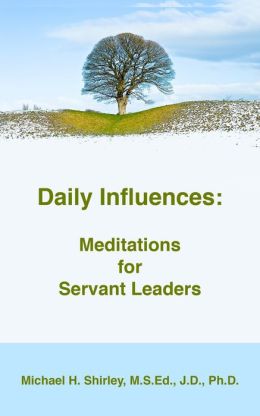
The book I just finished, Daily Influences: Meditation for Servant Leaders, grew out of my experiences as Leadership Development chairman for the Grand Lodge of Illinois. I’ve learned over the last few years that positive leadership is not something that’s necessarily based on talent, although talent helps. What matters is a person’s character. A person with bad character can be a very effective leader, but bad character begets bad results. A leader with good character who is equally effective will achieve positive results. Growing as a positive leader doesn’t happen overnight, and it’s not something we can do in fits and starts: it’s a daily effort. My book is designed to kick start that effort every day.

I’m pretty busy, so finding time to write was a challenge, but I finally settled into the habit of writing every morning. I didn’t work on the book every day, as I had other things to write too, and I had nine days over the course of a year when I didn’t write, and most of those were when I was on vacation with my family. What mattered was not the amount of writing: it was the habit of writing. Every day, I got up, sat down at the computer, and worked. And it is work. Thinking out what I want to say and how I want to say it is effortful in the best sense of the word. I’ve found, however, that most people don’t look at writing that way.

I’ve been a teacher for nearly thirty years, and have taught writing in some form for most of that time, and I’ve discovered that a lot of my students find writing to be a mysterious and fearful process. They avoid it even when they have to do it, and then bang out some words that meet the minimum required by an assignment, print it up, turn it in, and forget about it. They think writing is a product of words put together to satisfy a form. “How long does it have to be?” they ask. “Long enough to say what you need to say,” I reply. The good writers among them understand that, and start early, drafting and redrafting until they’re satisfied. Most of them, though, have been rewarded for big words, complicated sentences, and passive voice. They write in what Richard Lanham calls “The Official Style,” full of prepositional phrase strings, passive voice, and inexact but inflated words. It’s a nice way for a writer to give the appearance of having said something without actually taking responsibility for it. 

But writing is a form of thought, and unclear writing reflects unclear thought. I work out what I think by writing about it, and in that I’m not alone. H.L. Mencken was once asked what he thought about an issue, and replied, “How would I know? I haven’t written about it yet.” Writing forces me to sit down and wrestle with ideas, figure out where my logic fails, see which thoughts I need to develop more fully, and finally come to some conclusion I’m willing to stand by. It requires me to respond to things, rather than just react, because reacting has no thought involved. If I react, it’s a matter of instinct, rather than volition. To respond requires active thought that leads to a conscious choice. My students often use “I feel” rather than “I think” for two reasons: first, because they don’t know the difference; and, second, because you can’t argue with feelings. It’s an unconscious way of avoiding responsibility for what they say. 

I used to do the same thing, but now I seek to write on purpose, to choose words for their meaning and sound, and to build them into sentences and paragraphs that will bear real weight. I began to be a writer instead of a typist when I saw the English sentence as a noble creation. The late Eudora Welty said it best in her memoir, One Writer’s Beginnings: “I could see the achieved sentence finally standing there, as real, intact and built to stay as the Mississippi State Capitol at the top of my street, where I could walk through it on my way to school and hear underfoot the echo of its marble floor and over me the bell of its rotunda.” The achieved sentence is something I aspire to every time I sit down at the computer or pick up a pen. I sit, and think, and struggle for words. Sometimes they come easily, and sometimes I write three and erase four in an hour. But I’ll keep at it, and hope, when it’s time to stop for the moment, that I’ll have achieved something that’s built to stay. 

So to the readers of this blog, I say “thank you.” If what I do here provides you with something you value, I am truly grateful you found it so. If not, perhaps my blogmates’ work will strike a chord. In either case, I’ll keep writing. I have to.

~MHS

R.W.B. Michael H. Shirley is Assistant Area Deputy Grand Master for the Eastern Area for the Grand Lodge of Illinois A.F. & A.M, as well as a Certified Lodge Instructor and Leadership Development Chairman for the Grand Lodge of Illinois. A Past Master and Life Member of Tuscola Lodge No. 332, a plural member of Island City Lodge No. 330, F & AM, in Minocqua Wisconsin and he is also a member of the Illinois Lodge of Research, the Scottish Rite, the York Rite, Eastern Star, and the Tall Cedars of Lebanon. The author of several articles on British history, he teaches at Eastern Illinois University.